
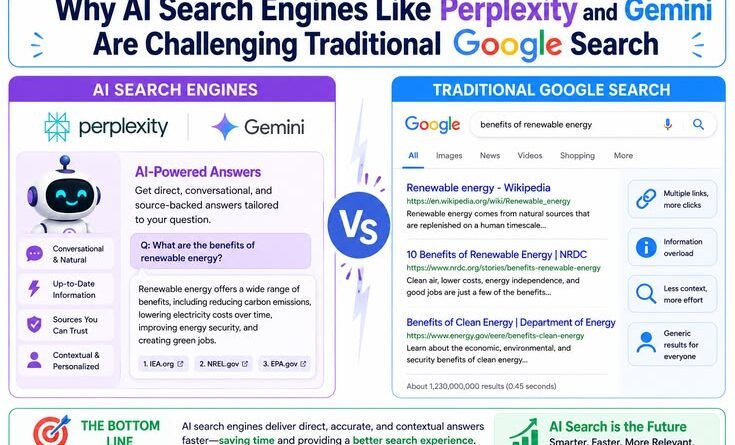
Why AI Search Engines Like Perplexity and Gemini Are Challenging Traditional Google Search
When I thought I was just testing a new tool. Turns out, I was rethinking how I find information entirely.
About a year ago, I was stuck on a frustrating research task — trying to understand how compound interest on a home loan actually works in practice, not in theory. I typed my question into Google, hit Enter, and landed on what I always land on: a wall of ads, three “people also ask” dropdowns, a Wikipedia summary, and five blog posts all saying the exact same thing in slightly different fonts.
Out of mild irritation, I opened Perplexity in another tab and asked the exact same question. The answer came back as a clean, sourced explanation — no ads, no filler, no ten blue links I had to evaluate and click through. Just an answer. With citations.
I sat there for a moment feeling genuinely confused. Not about the loan — about why I hadn’t been using this thing earlier.
That moment stuck with me, and it sent me down a rabbit hole of testing AI search tools — Perplexity, Gemini (Google’s own AI search layer), ChatGPT search, and even the AI Overviews now baked into standard Google results. What I found isn’t a simple “Google is dying” story. It’s messier and more interesting than that.
The Core Problem with Traditional Search (That We All Just Accepted)
Here’s something we normalized without realizing it: Google doesn’t actually answer questions. It finds pages that might contain answers. That’s a meaningful distinction.
When you ask “what’s the best way to treat a mild ankle sprain at home?” — Google gives you links. You open three of them, skim past ads and email popups, triangulate the answers yourself, and eventually piece together something useful. You did the work. Google just handed you a map.
We’ve been outsourcing the retrieval of information, but not the synthesis of it. AI search flips that completely.
For simple, factual queries — “what year was the Eiffel Tower built,” “nearest petrol station” — Google is still faster than blinking. But for anything that requires nuance, comparison, or explanation? That’s where the new generation of AI search tools starts to feel genuinely different.
What Perplexity Actually Gets Right
I’ve been using Perplexity almost daily for the past eight months. Here’s what actually impressed me, beyond the initial novelty:
It answers like a person, not a librarian
When I asked “Is it worth switching from Android to iPhone mid-year given the current trade-in values?”, Perplexity didn’t just link me to comparison articles. It synthesized current trade-in data, explained the timing considerations, and flagged that switching ecosystems has friction costs beyond the price. That’s the kind of response you’d get from a tech-savvy friend — not a search engine.
Citations are built-in, not optional
Every answer comes with numbered source citations you can actually verify. I’ve tested this repeatedly. The sources are real, the citations are accurate, and crucially — you can click through and read more if you want to. It doesn’t trap you in a walled garden. It feels like a starting point, not an endpoint.
Follow-up questions are natural
The conversation model matters more than I expected. If I ask about protein intake for muscle building, then follow up with “what about for someone over 50?”, Perplexity holds context. Traditional search resets with every new query. That thread of continuity changes how you research.
Real-world example: I was comparing two graphics cards for a PC build. On Google, I spent 45 minutes across seven tabs. On Perplexity, I asked “RTX 4070 vs RX 7800 XT for 1440p gaming at under ₹50,000 in India” and got a structured breakdown in about 90 seconds, with benchmark sources and caveats about driver stability. I still opened two links to verify — but I knew which two links to open.
Where Gemini Fits In — and Why It’s Different from Perplexity
Gemini is Google’s answer, and it’s worth separating two things: the Gemini app/website (more like a ChatGPT competitor) and the AI Overviews feature now embedded inside regular Google Search results.
The AI Overviews rollout was… rocky, to put it kindly. Early on, there were well-documented cases of wildly incorrect suggestions — the kind that made people screenshot and tweet in disbelief. Google has tightened things up considerably since then, but the trust damage from those early gaffes lingers.
That said, Gemini’s advantage is obvious: integration. If you use Gmail, Google Docs, Google Calendar, and Google Photos, Gemini can connect the dots across all of them. Ask it “did I share that project proposal with Ravi last week?” and it can actually check. Perplexity can’t do that. No external AI search tool can, unless you’ve set up integrations.
Perplexity: Clean, citation-first answers. Strong for research tasks. No ecosystem lock-in. Less personalization. Pro plan needed for some models.
Gemini: Deep Google ecosystem sync. Works across your Gmail, Drive, etc. Better for personal context. Trust still recovering from early errors. Sometimes feels cautious to a fault.
The Honest Limitations — Because These Tools Aren’t Magic
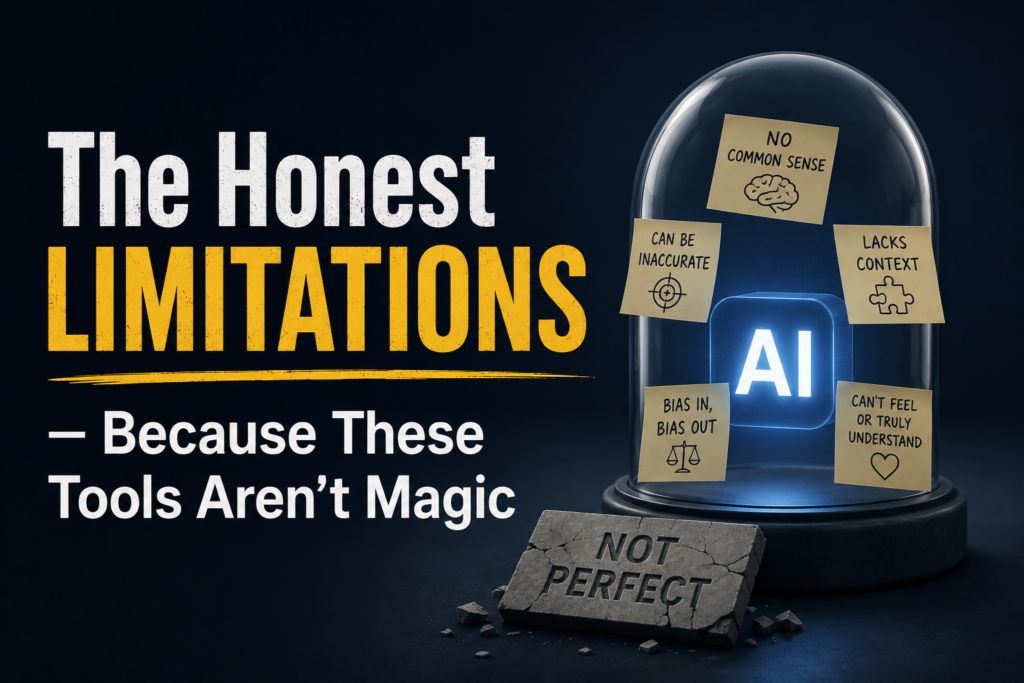
I’ve gotten things wrong because I trusted AI search too quickly. Let me save you some trouble.
Hallucinations still happen. Perplexity is much better than pure LLM chatbots at this because it grounds answers in live sources — but I’ve still caught it paraphrasing a source in a way that subtly changed the meaning. Always click through on anything high-stakes: medical, legal, financial.
Very recent events can be patchy. For breaking news, fast-moving topics (stock prices, live scores, same-day announcements), traditional Google News still wins. AI search tools vary in how current their data actually is.
Local search is still weak. “Best biryani near Jodhpur right now” — Google Maps beats every AI search tool I’ve tested. Hyper-local, real-time, ratings-based searches still belong to traditional search.
They can be confidently wrong. The conversational tone of AI answers can make incorrect information feel authoritative. A page of blue links at least signals “go verify this yourself.” A confident paragraph doesn’t always carry that same warning.
So… Is Google Actually Under Threat?
Honestly? Yes. But not in the way most headlines suggest.
Google isn’t going to disappear next year. It has infrastructure, brand trust, and advertiser relationships that can’t be replicated overnight. What’s actually happening is quieter and more interesting: the search behavior of a certain type of user — researchers, professionals, curious heavy users — is shifting. Not all at once, but steadily.
I used to open Google roughly 30 times a day. Now, I’d say maybe 15 of those have shifted to Perplexity or Gemini depending on the task. That’s half. For a platform that makes nearly all its money from search ads, that’s not trivial — even at scale.
Google knows this. The AI Overviews feature is their acknowledgment that the product needs to evolve. The question is whether they can adapt fast enough without cannibalizing their own ad revenue in the process. That’s a genuinely hard problem with no clean solution.
How to Actually Use These Tools Well
After months of testing, here’s the rough workflow I’ve landed on:
Use Perplexity for research tasks, comparison questions, “explain this to me” queries, anything where you need synthesized information from multiple sources quickly.
Use Gemini for tasks that involve your Google ecosystem — finding emails, summarizing documents in Drive, pulling calendar context into a conversation.
Stick with Google for local search, shopping (where you want to browse, not be told what to buy), very recent news, image search, Maps, and anything where you want to evaluate sources yourself before trusting a summary.
The best search strategy right now isn’t picking one tool — it’s knowing which tool is right for which question.
One Mistake I Made Early On
I went all-in on Perplexity for everything, including a health-related question about a recurring symptom. The answer was well-sourced and calm. I took comfort in it and didn’t book an appointment. That was dumb on my part. AI search is remarkable for synthesizing public information — but it doesn’t know your history, can’t examine you, and carries no liability for getting it wrong. I use it to prepare for conversations with doctors, not replace them.
The same logic applies to legal and financial questions. Use it to get educated, then take that education to an actual professional.
Where This Is All Heading
The underlying technology is moving fast. What Perplexity can do today is noticeably more capable than it was eighteen months ago. Gemini’s reasoning has improved substantially. Google’s own AI features, despite the rough start, are getting sharper.
What we’re watching isn’t a single disruption — it’s a slow renegotiation of what “search” even means. For a long time, search meant: here are ten doors, you pick which one to open. What’s emerging looks more like: here is what’s behind the doors, sourced and synthesized, with the doors listed in case you want to check.
That shift changes habits. Habits change traffic. Traffic changes revenue. Revenue changes who survives.
I’m not betting on any one outcome. But I am, pretty much every day now, reaching for Perplexity before I reach for Google. And I don’t think I’m alone in that.



Pingback: Why Tech Companies Are Building AI Devices That Can Understand Human Conversations Better
Pingback: Why Companies Like OpenAI, Anthropic, and Meta Are Investing So Heavily in AI
Pingback: How Smart Devices Are Starting to Understand Human Emotions