
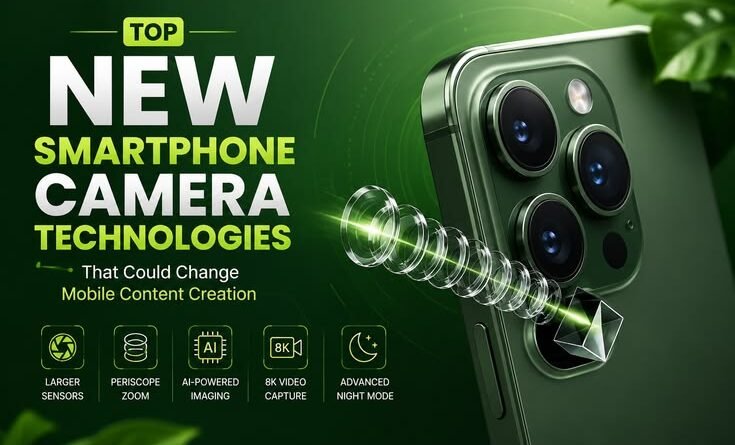
Top New Smartphone Camera Technologies That Could Change Mobile Content Creation
Published by a creator who’s been shooting content on a phone since before it was “a thing”
Yes I still remember the embarrassment. It was 2022, and I’d just shown up to a brand collaboration shoot with my DSLR — this massive chunky thing hanging around my neck — while the other creator on the job pulled out her iPhone, shot everything in under an hour, and delivered edited clips to the client the same evening. The brand loved her work. Mine sat in Lightroom for three days.
That was the moment I stopped treating smartphone cameras as a backup option and started paying serious attention to what was actually happening inside them.
And what’s happening right now? It’s genuinely wild.
The Gap Between “Phone Camera” and “Camera” Is Almost Gone
Let me be honest — there’s still a gap. A full-frame sensor on a Sony A7 will always behave differently from a 1/1.28-inch mobile sensor. Physics doesn’t care about marketing budgets.
But the practical gap — the one that matters for Reels, YouTube, brand content, travel vlogs, product shots — is shrinking so fast it’s making a lot of professional gear look overpriced and overly complicated.
The technologies driving that shift are worth understanding. Not just so you can geek out, but so you can actually use them better.
1. Computational Photography Is No Longer Just HDR
A few years back, “computational photography” basically meant your phone would smash a few frames together and call it HDR. It was fine. Mostly it meant your photos looked slightly over-processed and your sky went a weird teal color.
Now it means something completely different.
The Pixel 9 Pro’s “Add Me” feature, Apple’s Photonic Engine, Samsung’s ProVisual Engine — these aren’t gimmicks. They’re using AI to do things in milliseconds that would take a skilled retoucher twenty minutes. Real-time noise reduction. Semantic segmentation (the phone literally knows what a face is, what a sky is, what a dog is — and processes each differently). Highlight recovery that works in-camera before you even see the file.
I shot a sunset in Jaisalmer last winter with just my Pixel. The sky was blowing out, the foreground was practically black. The phone’s computational stack just… handled it. Not perfectly, but well enough that I posted it immediately without editing.
That used to require shooting RAW and spending time in Lightroom. Now it’s a default.
What this means for creators: You can shoot faster, worry less about exposure, and still get usable content. Great for fast-moving content like events, travel, and street.
2. Variable Aperture Is Back — and It Actually Matters This Time
Samsung brought variable aperture to the S9 in 2018 and then quietly dropped it. It felt like a gimmick. It was, a little.
But the newer implementations — especially in flagship Android devices — are doing it properly. The Galaxy S25 Ultra uses software-simulated aperture control combined with actual multi-lens switching to give you meaningful depth-of-field control.
More interesting to me personally is what this does for video. Real shallow depth with subject separation used to require either a big sensor or an anamorphic lens attachment (I tried the Moment lenses — they’re good, but fiddly). Now you can get that cinematic look handheld, no attachment, no rig.
Mistake I made early on: I used to crank bokeh to maximum in Portrait Mode because it looked “professional.” It looked fake. Real lenses don’t work like that. Now I dial it back to f/2.8 equivalent and the results look much more natural.
3. Periscope Telephoto Changed What “Zoom” Means
Before the periscope lens came along, optical zoom on phones maxed out around 3x before you started losing quality. Everything past that was digital zoom, which is just cropping with extra steps.
The periscope system folds the optical path inside the phone body, letting manufacturers fit a much longer focal length without making the phone thicker. The result: the iPhone 15 Pro Max ships with a 5x optical zoom. The Samsung S25 Ultra goes to 10x optical. Xiaomi’s 14 Ultra hits 5x with a massive floating lens that actually adjusts.
I used the S24 Ultra’s 10x zoom to shoot a camel fair from a rooftop in Pushkar. Got crisp, usable shots from a distance that would have required a 400mm lens on a DSLR setup. Obviously compressed perspective, but for documentary-style content? Unreal.
Practical tip: The sweet spot isn’t always max zoom. On most phones, 3x–5x optical zoom gives the best balance of quality and working distance. I use 5x as my “portrait focal length” now — it compresses backgrounds naturally and flatters faces much more than wide-angle.
4. Sensor Size Is Finally Getting the Attention It Deserves
For years, manufacturers competed on megapixels. It was mostly marketing. A 108MP sensor on a tiny chip captures less light than a 12MP sensor on a larger chip. Megapixels don’t make good photos in low light. Physics does.
The shift to larger sensors — 1-inch class sensors in phones like the Xiaomi 14 Ultra and Sony Xperia 1 VI — is a real change. More surface area means more light-gathering ability, which means cleaner low-light performance and better dynamic range without needing to rely entirely on computation.
The Sony Xperia line even lets you use real Alpha camera settings — full manual control, proper shutter speeds, customizable processing. If you’re the kind of creator who wants to shoot like a camera operator rather than pointing and letting the algorithm decide, these phones are genuinely interesting.
Real talk though: For most content creators, the computational processing on phones like the Pixel or iPhone still delivers better-looking results than raw sensor data from “camera phones” — because Google and Apple’s algorithms are just better tuned for social media output. Know your use case.
5. AI Video Features Are the Next Frontier
This is where things get genuinely exciting — and a little overwhelming.
Apple’s Cinematic Mode has been around since iPhone 13, but what it does is actually remarkable: it shoots video with a rack focus effect that you can change after recording. You can shift focus from foreground to background in post. It’s a feature that cinematographers spend years learning to execute smoothly on set.
Google’s Video Boost on the Pixel 9 Pro processes video in the cloud after capture, applying noise reduction and HDR correction that can’t run in real-time on the device. The results in low-light video are noticeably better than anything the device could do on its own.
Samsung is pushing AI-generated slow motion — using frame interpolation to generate smooth slow-mo from footage not actually shot at high frame rates. It’s not perfect (fast motion still shows artifacts), but for smooth panning shots and gentle movement, it’s convincing.
And then there’s the stuff coming down the line: real-time AI background replacement without green screens (we’re getting close), automatic color grading that matches your established aesthetic, voice-guided camera direction. Some of this is already in beta in various apps like CapCut and Adobe Premiere Rush.
The mistake most creators make here: They treat these AI features as shortcuts to avoid learning. Don’t. Understanding why Cinematic Mode works — aperture, focal length, subject distance — makes you use it better. The AI enhances skill; it doesn’t replace it.
6. Night Mode Video Is Finally Usable
Night photography on smartphones has been good for a while. Night video has been terrible for almost as long. The long exposures that make still night shots work don’t translate to video, and sensors have traditionally struggled with noise at 24fps in low light.
The latest generation is changing this. The Pixel 9 Pro’s Video Night Sight mode, combined with larger sensors and improved ISP (image signal processor) chips, is producing low-light video that would have been unusable from a phone two years ago.
I tested this at a dim rooftop restaurant in Mumbai — the kind of lighting where even Instagram’s filters give up. Shot a talking-head video on the Pixel 9 Pro. Slightly soft, yes. Grainy if you look closely. But color-accurate, not muddy, and totally usable for social content after a quick pass in DaVinci Resolve.
Common Mistakes Creators Make With New Camera Tech
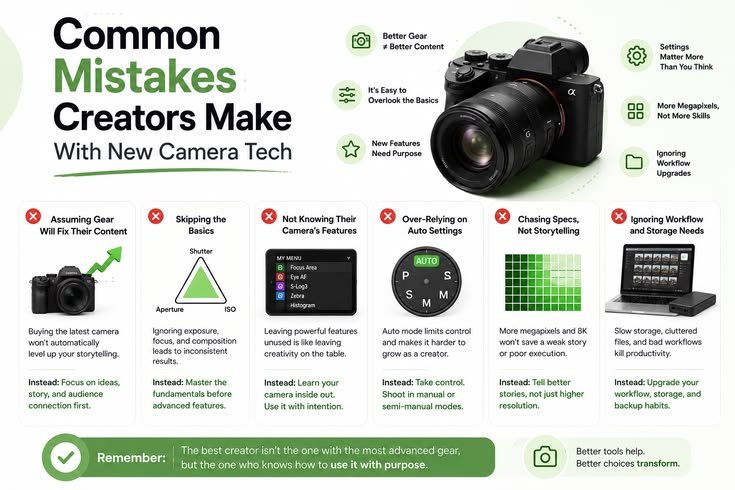
- Chasing specs over practice. The best camera is the one you understand. I know a travel creator who outperforms most iPhone 16 users on a two-year-old Pixel because she knows its quirks intimately.
- Ignoring lens choice. Your phone has multiple lenses. Most creators use the main lens 90% of the time. Try deliberately shooting a whole day on the ultrawide or the telephoto. You’ll start seeing differently.
- Shooting in the wrong format. If your phone supports Apple ProRes, Samsung RAW video, or 10-bit LOG profiles — use them for important content. Editing headroom is worth the storage cost.
- Not updating software. Camera software improvements are often delivered via updates, not hardware. Apple’s Photonic Engine was partly a software unlock. Keep your phone updated.
Where This Is All Going
The honest truth is that camera hardware on flagship smartphones is approaching a ceiling. You can only fit so much glass and sensor into a device that needs to fit in a pocket.
The next wave — which we’re already seeing — is software, AI, and post-processing. The competition is moving from “who has the biggest sensor” to “whose algorithm understands light, color, and composition better.”
For content creators, that’s actually great news. It means the tools keep getting better without requiring you to buy new hardware every year. It means your creative instincts matter more than your equipment budget.
I still respect the DSLR. I even still use one occasionally. But my phone is in my pocket every day, and the gap is closing faster than anyone predicted.
Start paying attention to the software updates. Start experimenting with the modes you’ve been ignoring. And next time someone pulls out a phone on a shoot — don’t underestimate them.