
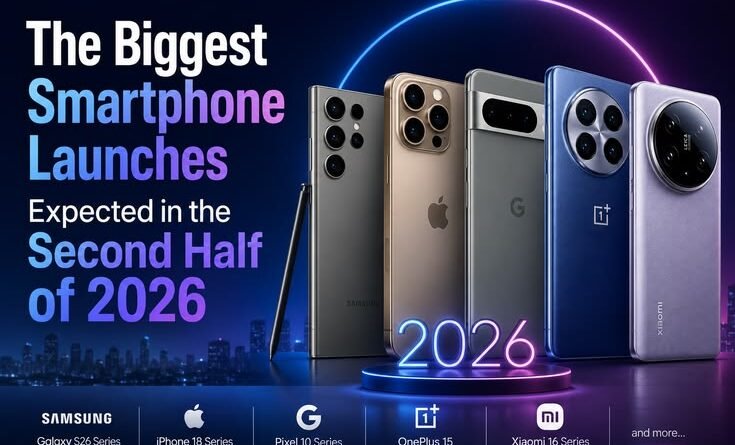
The Biggest Smartphone Launches Expected in the Second Half of 2026
Every year around May, I start doing the same thing — obsessively refreshing tech news sites, saving spec sheets I’ll never actually read twice, and making mental notes about which phones I’d actually consider buying. It’s a bit of a problem. My partner calls it “phone season anxiety.” I call it being informed.
This year is different though. Like, genuinely different. The second half of 2026 isn’t just shaping up to be another round of minor spec bumps and camera software tweaks. Some of the most anticipated devices in smartphone history are expected to land between July and December — and a few of them could actually change how we think about what a phone even is.
Let me walk you through what’s coming, what actually matters, and what you should realistically expect (versus what the hype machine wants you to believe).
Samsung’s Foldable Trio Is Coming — And It’s Getting Complicated
If you’ve been following Samsung’s Unpacked events, you know the drill. Every July, Samsung invites everyone to an event, shows off the new Z Fold and Z Flip, and the foldable world moves forward by one notch. This year, though, they’re doing something more interesting.
Samsung is expected to launch the Galaxy Z Fold 8, Galaxy Z Wide Fold, and Galaxy Z Flip 8 at a single event — with reports pointing to late July, likely around July 22, and London as the event location. Three foldables at once. That’s a big move.
The Galaxy Z Fold 8 is the flagship of the bunch. It could feature a 200MP primary camera with OIS, a 50MP ultrawide, and a 10MP telephoto — all expected to support 4K 60fps video recording with HDR10+. The one thing I’m most curious about: Samsung showcased a foldable display with no visible crease at CES 2026, hinting at what the Galaxy Z Fold 8 might offer, possibly using a dual-UTG structure and an improved hinge mechanism. Crease reduction has been foldable owners’ biggest gripe for years, so this is a meaningful step.
The Fold 8 is tipped to run the Snapdragon 8 Elite Gen 5 for Galaxy globally, with 12GB and 16GB RAM options, and storage up to 1TB. It’s expected to start at $1,999 for the 256GB model.
Then there’s the Galaxy Z Fold 8 Wide — which is actually more interesting to me personally. Instead of the tall, narrow proportions Samsung has used since the original Z Fold, the Wide model features a shorter, wider body with a 4:3 aspect ratio inner display — designed for landscape content, split-screen productivity, and a direct counter to Apple’s incoming iPhone Fold. Think less “tall notebook,” more “mini tablet that also folds.” If you’ve ever tried typing on a standard Z Fold with that cramped inner display aspect ratio, you’ll immediately understand why this matters.
The Galaxy Z Flip 8 is for the people who want foldable technology in a pocket-friendly form without the price of a house deposit. It’s expected to be slim at around 13.2mm when folded and 6.6mm unfolded, weigh about 180g (8g lighter than the Flip 7), and feature a 4.1-inch OLED cover display and a 6.9-inch foldable inner display. Pricing is expected to start around $949.99. The Flip is genuinely fun to use — I’ve spent time with previous generations, and the compact-when-closed form factor is something you either love immediately or wonder why you needed it. Most people land in the “love it” camp after a week.
One thing worth flagging: Samsung may be using older M13 OLED material for the Flip 8’s display to keep the price increase minimal — which means it may miss out on the 30% brightness and efficiency improvements of the M14 material used in the Galaxy S26 Ultra. That’s a real tradeoff.
Google Pixel 11 — The AI Phone Gets Even Smarter
Google has quietly become one of the most consistent phone makers out there. The Pixel line used to feel like a scrappy experiment. Now it’s a full-on flagship contender, especially on camera.
The Pixel 11 lineup is expected in August 2026, with the announcement window narrowed to August 17–25, and devices going on sale in mid-September. The range includes four models: the standard Pixel 11 (“Cubs”), Pixel 11 Pro (“Grizzly”), Pixel 11 Pro XL (“Kodiak”), and Pixel 11 Pro Fold (“Yogi”).
The big story here is the chip. The Tensor G6 is built on TSMC’s 2nm process — a genuine generational leap in power efficiency, more work per watt, less heat under load, and longer battery life even without increasing battery capacity. Apple’s A18 Pro was on 3nm. Google jumping to 2nm ahead of expectations is a legitimately exciting development if it translates into real-world performance — and not just benchmark bragging rights.
There’s also a rumored “Pixel Glow” feature found in Android 17 Beta 4 code — a hardware capability that changes the light and color on the back of the phone to inform you of notifications when the device is face down. That’s the kind of small, thoughtful detail that makes Pixel users feel like Google actually thought about how they use their phones. It’s not a reason to buy a phone by itself, but it’s an example of Google’s design philosophy.
Pricing may stay similar to its predecessor — the Pixel 10 Pro started at $999 — with analyst predictions putting the Pixel 11 Pro at $999 to $1,049 and the Pro XL at $1,249 to $1,299.
Where Google sometimes falls short is in the sensors themselves. The computational photography is brilliant, but rivals from Xiaomi, OPPO, and Samsung have been pulling ahead on raw sensor size and optical zoom hardware. If the Tensor G6 lets Google push on-device AI processing even further, the Pixel 11 Pro could leapfrog some of that gap without needing a 200MP sensor to do it. That’s the bet Google is making, and honestly, it’s worked so far.
The iPhone Fold — Yes, It’s Actually Happening
Okay. This is the big one.
I’ve been writing about foldable phones for years, and every single year since 2020, someone has said “this is the year Apple does a foldable iPhone.” Every year. And every year, nothing. I stopped believing it would actually happen around 2023.
But this time it’s real. Probably.
The foldable iPhone — widely referred to as the “iPhone Fold,” though Apple hasn’t confirmed that name — will be part of the fall 2026 lineup, introduced alongside the iPhone 18 Pro and iPhone 18 Pro Max in September.
Here’s the design: when closed, it will have a display of around 5.5 inches; when open, a much larger 7.8-inch display. It features a book-style form factor with both an outer and inner screen — and Apple has reportedly been obsessively focused on eliminating the crease, regardless of cost, developing a “new material property” that reportedly makes it nearly invisible.
The price will make you wince. Bloomberg’s Mark Gurman says it will “cross the $2,000 threshold,” and pricing estimates have settled around $1,999 for the base 256GB model, making it the most expensive iPhone ever made by a significant margin.
There are complications. Mass production was set to begin in June 2026 but was pushed back to August. If the iPhone Fold launches in September alongside the Pro models, it is likely to be in short supply — with reports suggesting production challenges could cause shortages into 2027. This is the part where I’d tell you: if you’re planning to buy one at launch, you should be ready to wait in a queue or get on a waitlist immediately.
The software side is also a legitimate question mark. Android has had seven years to build a foldable app ecosystem, and iOS 27 is effectively starting from scratch — developers will get tools to adapt existing apps for the 4:3 canvas, but how many are properly optimised at launch is a genuine unknown.
Still — Apple being last into the foldable market doesn’t have to be a disadvantage. They did exactly this with wireless earbuds (AirPods), smartwatches, and Apple Silicon. Watch the category, figure out what everyone got wrong, then release something that sets the standard. If the iPhone Fold is genuinely crease-free and runs a polished, optimized software experience, it could make every other foldable feel like a beta test.
iPhone 18 Pro — The Steady Upgrade
If $2,000 for a foldable feels too rich, the iPhone 18 Pro and Pro Max are the safer choice for the Apple faithful.
The iPhone 18 Pro models are expected to feature the same general design as the iPhone 17 Pro, with a triple-lens rear camera system and camera plateau. However, there are rumors of a variable aperture lens for the main camera — which would let users manually adjust how much light hits the sensor, reducing overexposure and giving new creative control. Variable aperture on a phone is something the OPPO Find X9 Ultra has already pioneered on Android, and if Apple brings their version of it to a mass market, it could genuinely shift how people shoot photos on iPhones.
Apple is also planning to split the iPhone 18 lineup, with the Pro and Fold models arriving in fall 2026, and the standard iPhone 18 and iPhone 18e launching in spring 2027 — a departure from Apple’s normal all-at-once approach. If you typically buy the base model, you might find yourself waiting longer than usual.
Common Mistakes People Make Around Phone Season
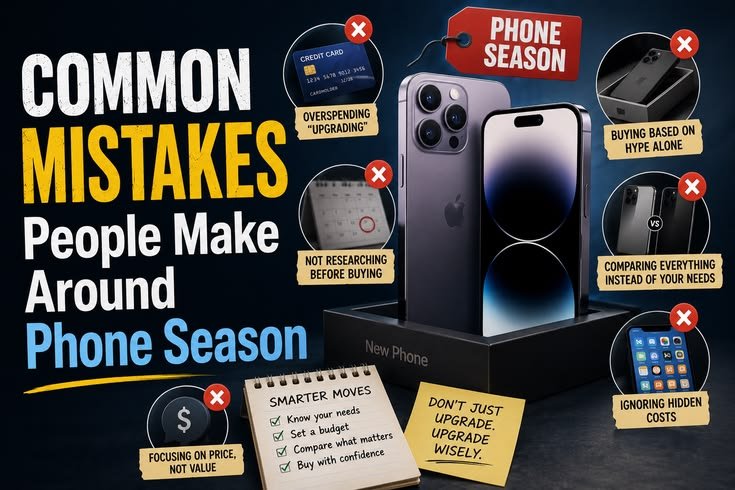
I’ve learned a few things from going through too many upgrade cycles:
Don’t buy purely on specs. The best phone for you isn’t always the one with the highest megapixel count. Think about how you actually use it — whether that’s camera, battery life, one-handed use, or software smoothness.
Wait two weeks after launch. Reviews from the first 48 hours of any flagship launch are rushed. Give it two weeks for proper battery life tests, real-world camera comparisons, and the inevitable software bugs to surface (or get patched).
Foldables are still not for everyone. They’re thinner and better than they used to be, but they’re heavier than regular phones, more delicate, and the software ecosystem for large inner screens — especially on the iPhone Fold — is still maturing. If you’re the type to crack a screen on a regular phone, a foldable isn’t the move.
The best deal isn’t at launch. If you can wait until November or December, carrier trade-in deals and holiday promotions typically knock $400–600 off flagship prices with eligible trade-ins. Patience pays.
What Should You Actually Be Watching For?
The second half of 2026 is genuinely stacked. To summarize the key windows:
July is Samsung’s month — the Z Fold 8, Z Fold Wide, and Z Flip 8 all expected at Unpacked. August belongs to Google, with the Pixel 11 lineup. September is Apple’s event — iPhone 18 Pro, Pro Max, and (if supply holds) the foldable iPhone.
The biggest unknown is how Apple’s entry into foldables reshapes the whole market. If the iPhone Fold gets strong reviews, Samsung, Google, and everyone else will feel immediate pressure. If it launches with app compatibility issues and supply shortages, it might be a December talking point rather than a September must-have.
Either way, the next six months are going to be worth paying attention to — even if, like me, you end up just watching everyone else buy the new phones while waiting for your current one to slow down enough to justify the upgrade.




Pingback: Top New Smartphone Camera Technologies That Could Change Mobile Content Creation – MSR Technical