
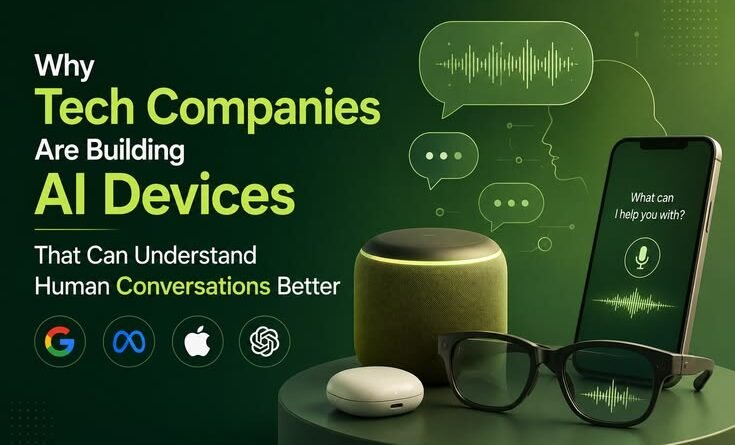
Why Tech Companies Are Building AI Devices That Can Understand Human Conversations Better
When I remember the exact moment I realized how broken voice tech was.
I was standing in my kitchen, both hands covered in dough, trying to get my smart speaker to set a timer. “Set a timer for twenty minutes,” I said. It set an alarm for 8:20 PM. I said it again. It asked me to repeat. By the third try, I’d given up, wiped my hands, and just grabbed my phone.
That was 2021. And what frustrated me wasn’t that the device was dumb — it was that I knew it could do the task. It just couldn’t understand me properly. Couldn’t follow context. Couldn’t figure out what I meant, only what I literally said.
That gap — between what humans mean and what machines hear — is exactly what the biggest names in tech are racing to close right now. And the reasons why are more layered than most articles let on.
The Dirty Secret About Voice Assistants
Here’s something the product launch videos never tell you: most voice assistants aren’t actually “understanding” you. They’re matching patterns.
You say a phrase. The device breaks it into audio signals. Those signals get mapped to text. That text gets matched against a database of known commands. If your phrasing fits the pattern — great. If not, you get “I’m not sure I understand that.”
It’s less like talking to someone and more like shouting at a very specific keyword detector.
The problem is humans don’t talk in keywords. We use context. We trail off. We refer back to things we said ten minutes ago. We say “turn that off” without specifying what “that” is, because we assume anyone paying attention already knows.
The current generation of AI devices — Amazon’s new Alexa+, Google’s Gemini-powered Assistant, Apple’s smarter Siri tied into Apple Intelligence, and newer devices like the Rabbit R1 and Humane AI Pin (which had a rough launch but pointed toward something real) — are all trying to fix exactly this. They’re moving from pattern-matching to genuine conversational comprehension.
Why Companies Are Suddenly Investing So Hard in This
The short answer: the technology finally exists to make it work properly. The longer answer is more interesting.
The LLM breakthrough changed everything. When large language models like GPT-4, Claude, and Gemini showed they could follow multi-turn conversations, remember context, and respond with actual nuance — every hardware company on earth saw the same opportunity at the same time. Suddenly, the gap between “voice assistant” and “conversational AI” felt closeable.
The money is massive. Think about what a device that genuinely understands you unlocks. Smart home control that actually works the way you’d expect. Customer service calls handled without a script. Healthcare devices that can pick up on a patient saying “I’ve been feeling off lately” and know what follow-up questions to ask. Enterprise productivity tools where you dictate naturally and the system organizes your thoughts for you. The market for truly conversational AI hardware is in the trillions over the next decade.
Voice is the most natural interface humans have. We learned to type because we had to. Given the choice, most people would rather just talk. Companies know that whoever cracks natural conversation first will own the next interface layer — the way Google owned search or Apple owned touch. That’s an enormous incentive.
What “Understanding” Actually Means in Practice
I’ve been testing a few of these newer devices and apps over the past year, and there are a few specific things that make a genuine difference in real use.
Multi-turn context. This is huge. Old assistants forgot everything the moment you finished a sentence. New systems carry context forward. You can say “What’s the weather like in Mumbai this weekend?” and then follow up with “What about next Monday?” — and it knows you’re still talking about Mumbai. That sounds simple. It changes everything.
Handling ambiguity. Real conversations are full of vague references. “Can you move that meeting?” — which meeting? A good conversational AI asks a targeted clarifying question rather than either guessing wrong or throwing up its hands. I’ve seen the Gemini app handle this well in testing; it’ll say “Do you mean your 3 PM with the design team?” instead of a generic error.
Tone and intent detection. This is the frontier. Not just what you said, but how you said it. If someone says “great, another meeting” — that’s sarcasm. Systems that pick up on tone are starting to emerge, though most are still fairly early here.
Interruption handling. Human conversations are full of interruptions and self-corrections. “Actually, no — make that for Tuesday, not Thursday.” Old systems would either ignore the correction or get confused. Better systems treat the correction as the valid, final instruction.
The Mistakes Companies Are Still Making
This isn’t a pure success story. There are real stumbles happening in real time.
Overpromising the hardware. The Humane AI Pin is probably the most famous example. It launched with a vision of a pin-sized AI you’d talk to all day that would replace your phone for many tasks. The reviews were brutal — not because the idea was bad, but because the execution wasn’t ready. The processing was slow, the battery was short, and natural conversations still felt stilted. The vision was ahead of the actual capability.
Privacy engineering as an afterthought. Devices that genuinely understand you have to process a lot of what you say. Constantly. The companies doing this well (Apple’s on-device processing approach is notable here) are thinking hard about what data goes where. The ones doing it badly are creating real exposure. Consumers are slowly waking up to this distinction.
Ignoring accents and dialects. This is an embarrassingly persistent problem. Systems trained predominantly on certain English accents perform noticeably worse for speakers of Indian English, Nigerian English, Scottish English, and so on. I’ve seen this firsthand — I have friends who’ve essentially given up on voice assistants because they’re tired of being misunderstood three times before the device figures out what they’re saying. Any company claiming their AI “understands human conversations” while having this gap has a real credibility problem.
What Actually Works Right Now (No Hype)
If you want to experience what better conversational AI actually feels like today, here’s where I’d start:
- Google Gemini on Android — the multi-turn context handling is genuinely impressive for everyday tasks
- Apple Intelligence on iPhone 16 / recent Macs — particularly strong for email summarization and writing assistance that understands your own previous content
- Claude (the app, not just the web) — for longer, more complex conversations where context actually matters
- Amazon Alexa+ (recently relaunched) — still early but the LLM integration makes it markedly better for open-ended questions than the old rule-based system
None of these are perfect. All of them are meaningfully better than what existed two years ago.
One Thing Most People Get Wrong About This Technology
People assume the hard part is speech recognition — turning audio into text accurately. That problem is largely solved. Modern transcription is remarkably accurate.
The hard part is everything that comes after. Understanding that “Can you pull up that document we were discussing?” requires knowing who “we” is, which document, and when “were discussing” refers to. That requires memory, context, and a model of the world.
This is why throwing better microphones at the problem doesn’t help. The bottleneck is comprehension, not hearing.
Where This Is All Going
The companies that crack this aren’t just building smarter speakers. They’re building systems that can serve as genuinely useful thinking partners — devices that sit in the background of your day, understand what you’re working on, and respond naturally when you need them.
Think less “Siri, set a timer” and more a device that notices you’ve been on three back-to-back calls, knows you have a presentation in an hour, and says “Want me to pull up your slides and set a five-minute prep reminder?” — without you asking.
That’s the direction. Whether the current generation of devices achieves it or just approximates it varies wildly by product and use case. But the trajectory is clear, and the investments being made suggest this is no longer a side project for any of the major players.
The kitchen moment I described at the start — hands covered in dough, shouting at a speaker that can’t understand me — that specific frustration is genuinely close to being solved. The question now isn’t whether it’s possible. It’s which company does it without creeping everyone out in the process.
That’s the race worth watching.



Pingback: How AI Automation Tools Are Helping Businesses Save Time and Reduce Workload
Pingback: The Biggest Smartphone Launches Expected in the Second Half of 2026
Pingback: Best Free Productivity Apps Released This Year for Students & Professionals