
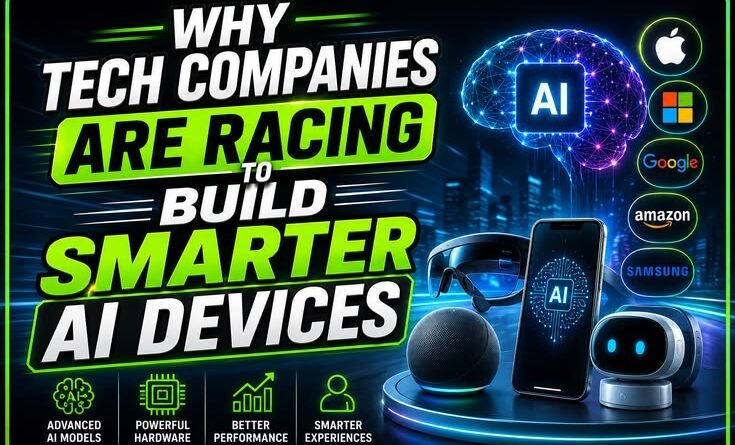
Why Tech Companies Are Racing to Build Smarter AI Devices
My Phone Started Finishing My Sentences — And I Wasn’t Sure How to Feel About It
A few months back, I was typing a message to my sister about a restaurant we’d been to years ago. I remembered the name started with “B” — something Italian — but that was it. Before I even hit the second letter, my phone suggested the full name. Correctly. I hadn’t searched for it. I hadn’t mentioned it recently. It just… knew.
I sat there for a second genuinely unsettled. Then I laughed, typed the name, and moved on with my day.
But that tiny moment stuck with me. Because it made me realize something: the race to build smarter AI devices isn’t really about technology flexing its muscles. It’s about companies trying to make themselves so deeply useful in your daily life that you’d feel their absence like a missing limb.
And right now, that race is moving faster than most people realize.
What “Smarter AI Devices” Actually Means (In Plain English)
When tech companies say they’re building “smarter” devices, they don’t just mean faster processors or better cameras — though those matter too. What they really mean is devices that understand context, predict your needs, and act on your behalf without you having to babysit them through every step.
Think about the difference between a calculator and a financial advisor. A calculator does exactly what you tell it. A financial advisor asks questions, notices patterns, and tells you things you didn’t even think to ask about.
That’s the shift happening right now — from devices that respond to devices that think.
Google’s Pixel phones have been doing on-device AI processing for a couple of years. Apple’s Neural Engine has been tucked inside iPhones since 2017. Samsung’s Galaxy S series now runs certain AI tasks entirely offline. And Qualcomm, which makes chips for a huge portion of Android phones, literally rebranded their flagship chip line around AI performance.
The hardware war is already here. Most people just haven’t noticed yet.
Why Everyone’s Suddenly in Such a Hurry
Here’s the thing that took me a while to fully understand: this isn’t just a feature competition. There’s a much bigger business reason driving all of this.
The platform shift argument. Every decade or so, the entire tech industry reorganizes around a new computing platform. PCs in the 80s. The internet in the 90s. Smartphones in the 2000s. Cloud in the 2010s. The companies that dominated each of those transitions — Microsoft, Google, Apple, Amazon — did so because they moved early and built deep into the platform.
AI devices are widely believed to be the next platform shift. And every major tech company is terrified of being the next Nokia — dominant until they weren’t.
The data advantage compounds. Smarter AI devices learn from you. And the more they learn, the more useful they get. The more useful they get, the more you use them. The more you use them, the more they learn. It’s a flywheel that, once spinning fast enough, becomes incredibly hard for a competitor to interrupt.
This is why companies like Meta are reportedly developing AI-first glasses and wearables. It’s why Amazon keeps iterating on Alexa despite years of mixed results. It’s not because these products are immediately profitable — they often aren’t. It’s because whoever wins the “ambient computing” space will own the next 20 years of tech.
Generative AI changed the calculus. Before ChatGPT blew up in late 2022, most device AI was narrow and boring — voice assistants that couldn’t handle follow-up questions, photo sorting that sometimes mis-identified people as pets. Then large language models arrived and showed everyone what was actually possible. Suddenly every device roadmap got ripped up and rewritten.
I watched this happen in slow motion. I covered a major consumer electronics event in early 2023, and the AI stuff was almost an afterthought — a few slides, some vague promises. By 2024, it was the entire show. Every company had “AI” plastered across their booth.
The Real-World Devices Driving This
Let me walk through what’s actually being built, because the landscape shifts fast and it’s easy to lose track.
AI PCs — Intel, AMD, and Qualcomm are all shipping chips with dedicated “NPUs” (neural processing units) specifically for running AI tasks locally. Microsoft’s Copilot+ PCs require a certain NPU performance threshold. The pitch: AI features that work even when you’re offline, faster, and without your data leaving your device.
Smart Glasses — Meta’s Ray-Ban smart glasses are genuinely impressive compared to where they started. The latest versions can identify objects, read text in your environment, and answer questions about what you’re looking at. Apple’s Vision Pro went in a different direction — more of a spatial computing platform — but the underlying idea is the same: merge the digital and physical.
AI Phones — Google’s Pixel 9 lineup and Samsung’s Galaxy S25 series both run significant AI workloads directly on the device. Live translation, real-time call summaries, photo editing that feels like magic — all happening on chips smaller than your thumbnail.
Personal AI Companions — This is the weird frontier. Devices like the Rabbit R1 and the ill-fated Humane AI Pin attempted to create entirely new form factors built around AI from the ground up. Most of them stumbled. But the attempt itself tells you something — companies are willing to bet big and fail publicly in this space.
What I Got Wrong Early On (And What That Taught Me)

When I first started paying close attention to this space, I made a classic mistake: I evaluated AI device features based on how impressive they were in demos.
The circle-to-search feature on Samsung phones? Phenomenal demo. I use it maybe twice a month. The AI-generated photo backgrounds? Wild to watch. I turned it off after a week.
What actually changes my day-to-day life is the quiet stuff. Predictive text that’s learned my vocabulary. The way my phone now auto-categorizes photos into trips without me asking. Background noise cancellation on calls that actually works.
The lesson: the best AI features aren’t the flashiest ones. They’re the ones that disappear into your routine so completely that you’d only notice if they vanished.
This is exactly what the smartest product teams seem to have figured out. The race to build smarter AI isn’t about building the most impressive AI — it’s about building the most invisible AI.
Common Mistakes People Make When Thinking About This
Assuming it’s just marketing. Some of it is, yes. But the underlying shift in hardware and software architecture is very real. Chips are being physically redesigned. Billions of dollars are moving.
Thinking the winner is already determined. It’s not. Apple has the ecosystem lock-in, Google has the data, Microsoft has the enterprise relationships, Meta has the social graph. Any of them could end up dominating. Or someone we haven’t heard of yet could pull a ChatGPT-level surprise.
Ignoring privacy as a feature. Apple has made on-device processing a selling point specifically because it keeps data off servers. This is increasingly something consumers actually care about. Companies that ignore this will have a problem.
Expecting linear progress. AI capabilities don’t improve in a straight line. There are plateaus, then sudden jumps. The companies building the best hardware infrastructure today are positioning for a jump that may or may not come on their expected timeline.
So What Does This Mean for You as a User?
Practically speaking? You’re going to get more capable devices whether you care about the AI race or not. That’s just the rising tide.
But here’s how to actually benefit from what’s coming:
Don’t chase the bleeding edge. The first-gen AI features on any device are usually rough. Wait for the second or third iteration. The Pixel 4 had face unlock that unlocked even when your eyes were closed. The Pixel 9 has features that just quietly work.
Pay attention to what runs on-device vs. in the cloud. This matters for speed, privacy, and reliability. Anything that requires an internet connection can fail, can get monetized later, and involves your data traveling somewhere.
Get comfortable with imperfect AI. The AI on your devices will make mistakes. It’ll misidentify things, suggest weird autocorrects, summarize emails incorrectly. The trick is to treat it like a helpful but occasionally clueless assistant — you’re in charge, it’s just making suggestions.
Think about switching costs differently. The smarter your device gets about you, the more painful it becomes to switch ecosystems. That’s not an accident. Go in eyes open.
The Bigger Picture Nobody Talks About Enough
There’s something genuinely strange about this moment. We’re building devices that learn us, predict us, and increasingly act for us — and we’re still figuring out what we actually want from that.
I’ve talked to people who find the predictive stuff deeply comforting, like the device is a thoughtful partner. I’ve talked to others who find it unsettling, like they’re being watched by something that’s getting too good at reading them.
Both reactions make sense. And both will shape how this technology develops, because companies ultimately build toward what users reward them for.
The race to smarter AI devices isn’t slowing down. If anything, the next two or three years will make the last five look like a warm-up. New chip architectures, new form factors, AI that can see and hear and reason in real time — it’s genuinely hard to predict where this lands.
What I do know is that the companies building these things aren’t doing it out of generosity or curiosity. They’re doing it because whoever wins this race wins the next era of computing.
And what you do with these devices — what you find useful, what creeps you out, what you actually pay for — is the signal that tells them which direction to run.
Have you noticed AI features on your devices actually changing how you work or live? I’d genuinely love to hear what’s working and what’s been more hype than substance — the real-world gap is always more interesting than the press releases.




Pingback: How Microsoft Is Bringing AI Features Into Windows and Office Apps Faster Than Ever
Pingback: How New AI Agents Are Automating Customer Support and Business Workflows – MSR Technical