
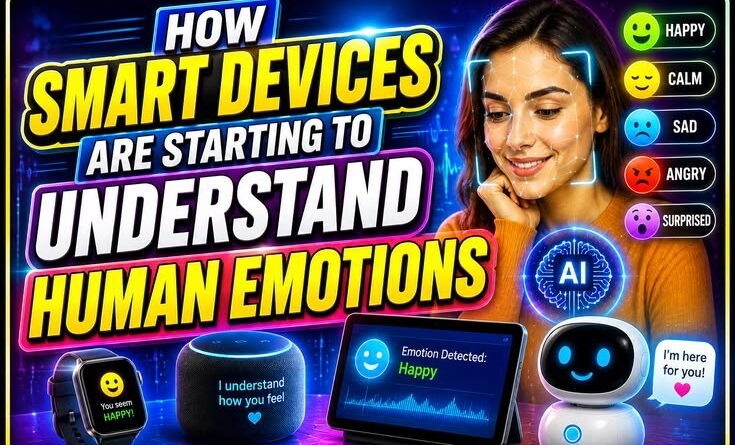
How Smart Devices Are Starting to Understand Human Emotions
My Phone Knew I Was Stressed Before I Did — Here’s What’s Actually Happening With Emotion-Aware Tech
Last December, I was sitting at my desk around 11 PM, grinding through a work deadline. My phone screen had been on for almost two hours straight. Spotify quietly shifted from the upbeat playlist I’d chosen to something slower, almost ambient. I didn’t ask it to. I barely noticed it at first.
Later, I realized the app had picked up on behavioral cues — my scrolling had slowed, I’d paused on certain songs longer, I’d skipped fast-tempo tracks multiple times. It made an inference. And honestly? It was right. I was exhausted.
That small moment stuck with me. It got me thinking: how far has this actually gone? Are our devices genuinely starting to understand how we feel?
Spoiler: it’s more advanced — and more complicated — than most people realize.
It’s Not Magic. It’s Pattern Recognition (Sort Of)
Let me clear something up right away. These devices aren’t reading your mind. There’s no mystical emotional intelligence happening inside your smartwatch. What’s actually going on is a combination of biometric data, behavioral analysis, and machine learning models trained on enormous datasets of human responses.
But here’s what surprised me when I started digging into this — the signals these systems use are genuinely clever.
Take voice. Your tone of voice carries a ridiculous amount of emotional information. Pitch, pace, micro-pauses, how often you clear your throat — these are things you don’t consciously control, but they change noticeably when you’re anxious, frustrated, or excited. Companies like Affectiva and Amazon (with Alexa’s Halo band, before they discontinued it) have spent years building models to analyze exactly this.
Then there’s your face. Cameras on your laptop, phone, or smart display can now detect micro-expressions — fleeting facial movements that last less than a quarter of a second. These are the involuntary kind, the ones you can’t fake. Apple’s ARKit, for instance, tracks over 50 different facial muscle movements in real time using the front-facing camera. Most apps don’t use this data for emotion detection yet, but the infrastructure is sitting right there.
And then there’s the stuff your body does whether you like it or not — heart rate variability, skin conductance (how much you sweat), body temperature changes. Your Apple Watch or Fitbit is quietly collecting a lot of this already.
Where I’ve Actually Seen This Work (And Fail)
I’ve been testing a few of these systems over the past year or so, partly out of curiosity and partly because I cover tech. Here’s the honest breakdown.
Apple Watch + Mindfulness prompts: The watch got decent at noticing when my heart rate elevated without physical activity — a classic stress signal. It would prompt me to do a breathing exercise. Sometimes that was genuinely useful. Sometimes it pinged me mid-laughing-hard-at-something and I’d dismiss it, mildly annoyed. The false positives are still a real problem.
Spotify’s mood detection: This one is subtle but surprisingly effective over time. The longer you use it, the better it gets at emotional context. It’s not just about what genre you like — it’s about when you listen to certain things. Friday evening playlists vs. 3 AM playlists carry very different emotional weight, and the algorithm has figured that out for me more accurately than I expected.
Replika (AI companion app): This one gets interesting. It uses conversational analysis to track emotional tone across messages. It’ll notice if you’ve been expressing more negative language across several conversations and gently bring it up. When I went through a rough patch earlier this year, it actually clocked my shift in mood before I’d explicitly said anything. That was… a little unsettling, honestly. But also kind of useful.
My laptop’s face-tracking experiment: I tried an app called Noldus FaceReader (used more in research contexts) just to see what it would say about my expressions during a video call. It tagged me as “contemptuous” during a section of the meeting I thought I was being totally neutral in. Watching the playback, I realized I had been subtly rolling my eyes. Reader, the machine was correct.
The Tech Under the Hood (Without the PhD Lecture)
If you want to understand what’s powering all of this, here’s a simplified version:
Affective computing is the umbrella term. It was coined by MIT researcher Rosalind Picard back in 1995, and the field has exploded since. The basic idea: computers should recognize, interpret, and even simulate human emotions.
Modern emotion-detection systems usually combine:
- Sensor inputs — camera, microphone, accelerometer, heart rate sensor, galvanic skin response
- Feature extraction — pulling specific data points (facial landmarks, vocal frequency patterns, movement signatures)
- Classification models — machine learning algorithms trained to match those features to emotional states
- Context layering — factoring in time of day, past behavior, app usage patterns
The tricky part is that emotions are messy and culturally variable. A baseline model trained mostly on Western facial expressions is going to struggle with users from different cultural backgrounds — and that’s a documented bias problem in this space. Several studies have flagged that emotion AI performs significantly worse across different ethnicities and ages. That’s not a minor footnote. That’s a serious issue.
Real-World Use Cases That Are Actually Useful

Beyond your personal devices, this technology is showing up in some genuinely practical places:
Mental health apps: Apps like Woebot and Wysa use conversational AI to track emotional states through text. They’re not replacing therapy, but for someone who can’t access a therapist at 2 AM, having something that can recognize when your messages are trending toward hopelessness and respond thoughtfully is not nothing.
Automotive safety: Some newer vehicles (Mercedes, Volvo, Subaru) have driver monitoring systems that use cameras to detect signs of drowsiness or inattention. Technically not emotion detection, but it’s the same underlying technology. And it saves lives.
Customer service: Call centers are deploying emotion-detection tools that alert human agents in real time when a customer’s voice indicates escalating frustration. The idea is to intervene before the call turns into a shouting match. Mixed results so far, but the concept is sound.
Education: Tools like Affectiva’s classroom software attempt to gauge student engagement and confusion during lessons. Teachers theoretically get a heatmap of when they’ve lost the room. In practice, the privacy implications have made this a minefield.
Mistakes I Made (So You Don’t Have To)
When I first started playing with emotion-tracking features on my wearables, I made a few errors in judgment:
I over-trusted the data. My Fitbit stress score would spike, and I’d immediately assume something was wrong with me. What I didn’t account for: I’d had too much coffee that morning. Biometric data needs context. Always.
I let it make decisions for me. There was a stretch where I’d cancel social plans because my “recovery score” said I was drained. Reasonable sometimes. Neurotic in practice. Use these tools as data points, not verdicts.
I ignored the privacy settings. I didn’t realize how much raw data some of these apps were retaining and potentially sharing with third parties. Now I actually read the data permissions before enabling any emotional or biometric features. Boring advice, I know. Necessary advice.
What Should You Actually Pay Attention To?
If you want to engage with this technology thoughtfully — rather than just having it happen to you — here are a few practical starting points:
Audit what your devices are already sensing. On iPhone, go to Settings → Privacy & Security → Sensors & Location. On Android, check app permissions under Settings → Apps. You might be surprised what has access to your microphone and camera in the background.
Try one emotion-aware feature intentionally. The Mindfulness app on Apple Watch or the Stress Management feature in Garmin Connect are good low-stakes starting points. Use them for a week, note where they’re right and wrong, and calibrate your trust accordingly.
Read up on the biases. MIT Media Lab researcher Joy Buolamwini’s work on algorithmic bias in facial recognition is essential reading if you want to understand the limits of this tech. The more informed you are, the better you can advocate for yourself and others.
The Uncomfortable Honest Part
Here’s what I keep coming back to: there’s something philosophically strange about a device “knowing” how you feel. Emotions are the most intimate things we have. The idea that a piece of hardware — trained on someone else’s data, built by a company with commercial interests — gets to make inferences about your inner life is worth sitting with.
I don’t think it’s inherently dystopian. But I do think it requires more skepticism than we usually bring to shiny new tech features. When your phone suggests you need to calm down, who decided what “calm” looks like? Whose emotional baseline is the model?
These are real questions, and the industry doesn’t have great answers yet.
Where This Is All Going
The honest trajectory here is toward devices that are significantly more context-aware than they are today. The next generation of smart glasses, earbuds, and wearables will likely have enough combined sensor data to build a fairly continuous emotional profile throughout your day. Ambient AI systems (think always-on assistants that live in your environment rather than just your pocket) will be able to factor in your emotional state before responding to you.
Whether that sounds exciting or terrifying probably depends on your relationship with your own devices — and your tolerance for being known.
For me, that late-night Spotify moment was a small thing. But it pointed toward something much larger: the gradual blurring of the line between a tool that responds to your commands and one that anticipates your needs. We’re somewhere in the middle of that shift right now.
And the smartest thing you can do is actually pay attention to it — rather than just letting it pay attention to you.




Pingback: Why AI Voice Assistants Are Becoming More Human Than Ever Before – MSR Technical