

The Most Futuristic Products Revealed by Tech Companies This Year
My wife has a running joke about me. Every January, she hides my credit card for a week — not because I’m bad with money, but because tech companies know exactly how to drain a bank account in the first quarter of the year. CES, developer conferences, product launches, keynotes… it’s a gauntlet. And 2026 has been, without exaggeration, the most disorienting one yet.
I spent the last four months tracking announcements, attending two physical events, watching way too many livestreams, and — crucially — actually getting my hands on a handful of these products early. Some of them made me feel like I’d jumped forward a decade. A couple of them made me feel like the future still has some serious UX bugs to work out. Let me walk you through what I think actually matters this year.
“The thing nobody tells you about truly futuristic products is that they don’t feel futuristic when you’re using them. They just feel obvious.” — Personal observation, after 3 weeks with the Samsung Spatial Glasses
The Year That Spatial Computing Got Serious
Last year, spatial computing was still a punchline. People kept posting memes of the Apple Vision Pro wearer alone on the couch at Thanksgiving. But something shifted in 2026. The headsets got lighter, the software got smarter, and — most importantly — the price stopped being a second mortgage.
01 · Samsung Spatial Glasses (Project Moohan 2nd Gen) Wearables · Spatial
I wore these for six hours straight on a work-from-home day. They sit on your face like regular eyewear — slightly chunky, yes, but not the brick strapped to your skull that earlier headsets were. The key upgrade here is the adaptive passthrough: instead of showing you a camera feed of the real world, the display seamlessly blends digital overlays into actual optical clarity. Your physical desk is your desk. The floating spreadsheet is just… there, above it. The moment I realized I’d stopped noticing the glasses, that’s when I understood this was different. Still expensive. Still limited in app support. But if you work from home and can expense it, this is the real deal.
02 · Rabbit R2 Pro — The “Actually Works Now” Comeback AI Hardware · Productivity
I was one of the people who bought the original R1 and felt burned. So when Rabbit announced the R2 Pro in February, I almost scrolled past it. Then I saw the demo. The thing that broke me was watching someone tell it to “rebook my Tuesday flight, find a hotel near the venue, and email my client the new arrival time” — and it did all three, sequentially, with zero hand-holding. No app-switching. No typing. The R2 Pro runs what they’re calling a “compound agent” system, not just a chatbot layer on your phone. I’ve been using it for three weeks. It’s saved me about 45 minutes a day. That number surprised even me.
The AI Hardware Wave — What’s Real, What’s Hype
Here’s where I want to slow down, because this is the category where I’ve seen the most confusion — and the most people spend money they shouldn’t have.
Every week this year, a new “AI-first device” has been announced. Pins, pendants, glasses, earbuds that narrate your life. The marketing is always the same: “It knows you. It learns from you. It’s always on.” And the reality? Mixed. Very mixed.
Quick tip: Before buying any AI hardware gadget, ask yourself — does this genuinely replace something I already do, or is it just adding a new thing to manage?
The honest distinction I’ve learned to make is this: does the device fit into a workflow I already have, or does it require me to build a new one? The Rabbit R2 Pro works because booking travel is a task I was already doing 10 times a week. It slotted in. Meanwhile, I returned a well-hyped “AI pendant” from a startup I won’t name because after two weeks, I realized I was narrating my day for an app that wasn’t meaningfully improving it.
That said, there are three AI hardware products this year that I think are genuinely worth your attention.
03 · Google Pixel Watch Ultra — The Health Passport Health Tech · Wearables
The hardware spec bump matters less than the software here. Google’s “Health Compass” feature on the Watch Ultra is the first consumer wearable system I’ve used that gives you a genuinely coherent picture of your health over time — not just today’s step count, but longitudinal patterns explained in plain language. It flagged a subtle change in my resting heart rate variability three weeks before I ended up with a bad chest cold. Coincidence? Maybe. But my doctor was impressed with the data I brought in. The watch also now handles real-time ECG with AFib detection that’s been cleared in most major markets. It’s not cheap, but this feels like the category finally maturing.
04 · Amazon Echo Horizon — The First Smart Speaker That Anticipates AI · Home Automation
Amazon’s been playing catch-up in AI for a while. The Echo Horizon is their comeback. What’s different is the shift from reactive to proactive. The device doesn’t wait for you to ask things anymore. By 7:15 AM, without me saying a word, it had already told me my 9 AM call was rescheduled, that rain was expected around my commute time, and that I was almost out of coffee because it cross-referenced my shopping history. I know that sounds invasive. Honestly, the first week it felt that way. By week two, I’d stopped feeling anxious about it and started just… relying on it. That psychological shift is what Amazon has been trying to engineer for years. They’ve finally done it.
Robotics Stepped Off the Stage and Into the Living Room
I need to talk about robots. Not in the vague, science-fiction way — in the “there’s a machine folding laundry in my neighbor’s apartment” way.
Two announcements this year stood out from the noise:
05 · 1X Technologies NEO Gamma — Home Robots Get Real Robotics · Home
Norwegian startup 1X has been quietly building toward this moment. The NEO Gamma is a bipedal home robot designed for light household tasks — loading and unloading a dishwasher, tidying surfaces, moving objects. I watched a 40-minute live demo at their February event and only spotted one fumble (it knocked a small plant off a shelf, then helpfully picked it back up). The price point — around $30,000 at launch — is still science fiction for most households. But the fact that it works in cluttered, non-controlled environments is the real breakthrough. This is the demo that made investors forget about Elon’s Optimus claims entirely.
06 · Figure 02 — The Robot That Learned to Think on Its Feet Robotics · Industry / Consumer
Figure AI’s second-generation humanoid made waves not because of what it can physically do (previous models could already stack boxes faster than most warehouse workers), but because of how it handles unexpected situations. In their March keynote demo, an engineer deliberately cluttered the workspace mid-task — moving boxes, blocking paths, adding obstacles. The Figure 02 paused, reassessed, changed its approach, and completed the job. No reset. No human intervention. That adaptive reasoning in unstructured environments is the hard problem of robotics. Watching it play out in real time was genuinely startling.
“The hard problem of robotics isn’t making something that works in a lab. It’s making something that handles your messy, chaotic, constantly changing real life.”
The Display Revolution Nobody Is Talking About Enough
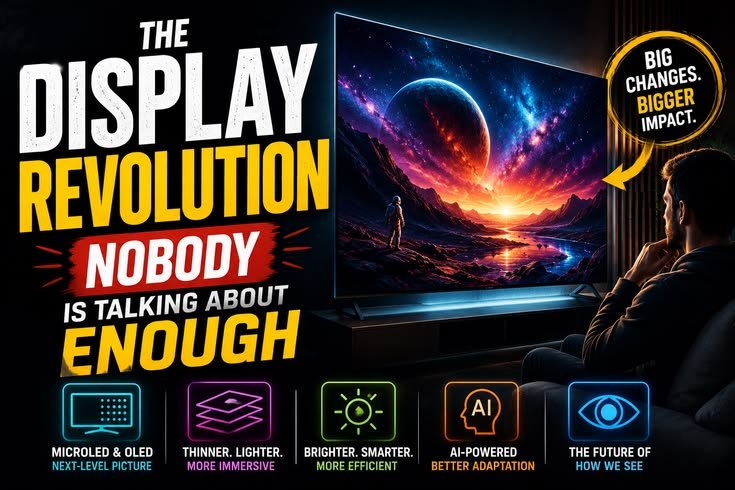
Between spatial computing headlines and robot demos, one of the genuinely impressive tech shifts of 2026 has flown under the radar: the death of the rectangle.
LG and Samsung both unveiled rollable and slidable displays this year that have moved out of prototype stage and into actual shipping products. The LG Signature OLED Rollable TV — which literally retracts into a cabinet console when not in use — is now available in Europe and parts of Asia. I’ve seen it in person. The experience of a screen rising out of furniture is hard to describe without sounding like you’re overselling it. You’re not.
On the phone side, Motorola’s Rizr G2 features a screen that slides upward to nearly double its surface area. I had it for a week on loan. The mechanism felt surprisingly solid. The use case — switching from phone mode to tablet mode without carrying two devices — is the kind of thing that sounds gimmicky right up until you’re using it to review a document while still holding a normal-sized phone. Then it makes total sense.
Common Mistakes People Make Buying Futuristic Tech
I’ve made most of these myself at some point:
Buying the promise, not the product. Early-gen tech is bought by people who want to be part of the story. That’s fine, but know what you’re paying for — you’re not buying a finished product, you’re backing a direction.
Ignoring the ecosystem. The coolest hardware in the world becomes a paperweight if the app support is weak or the company abandons it in 18 months. Check the roadmap. Check the company’s history. I’ve had three “futuristic” gadgets become orphaned in three years.
Skipping the return window test. The only real review of a futuristic product is whether you miss it when you send it back. If you don’t — and you have to be honest with yourself about this — it wasn’t for you yet.
Underestimating the learning curve. Products that genuinely change how you work usually require a few weeks of discomfort before they click. Most people give up on day three and declare the product bad. Sometimes they’re right. Sometimes they just needed day eleven.
Forgetting the privacy question. The more a device “knows” you, the more data it collects. I’m not saying don’t buy them — I clearly do. But read what’s being logged. Know where it goes. Make an active choice, not a passive one.
What I’m Actually Keeping From This Year’s Wave
After all the demos, all the loans, all the living with these things — here’s the honest short list of what’s earning a permanent spot on my desk or my wrist.
The Rabbit R2 Pro has become a genuine part of my workday. The Google Pixel Watch Ultra is on my wrist every day and I actually look forward to my health summary each morning, which I would never have predicted two years ago. And the Samsung Spatial Glasses are on a 90-day trial that I’m increasingly certain will not end with me returning them.
Everything else — the robots, the rolling screens, the proactive speakers — I admire enormously. I think they’re real signals of where things are heading. But they’re not ready for everyone yet, and more importantly, everyone isn’t ready for them.
Here’s the thing about living through a technological leap in real time: it rarely arrives as a single moment of clarity. It’s more like waking up one Tuesday and realizing that four things you couldn’t do a year ago are now just… part of how you live. That’s happening right now, in 2026, faster than I’ve ever seen it happen before.
Pay attention. And maybe hide your credit card for a week, just to be safe.
Disclosure: The author received loan units of the Samsung Spatial Glasses and Google Pixel Watch Ultra for review purposes. The Rabbit R2 Pro and Motorola Rizr G2 were purchased personally. No manufacturer had editorial input on this article. Views are entirely the author’s own based on hands-on use.
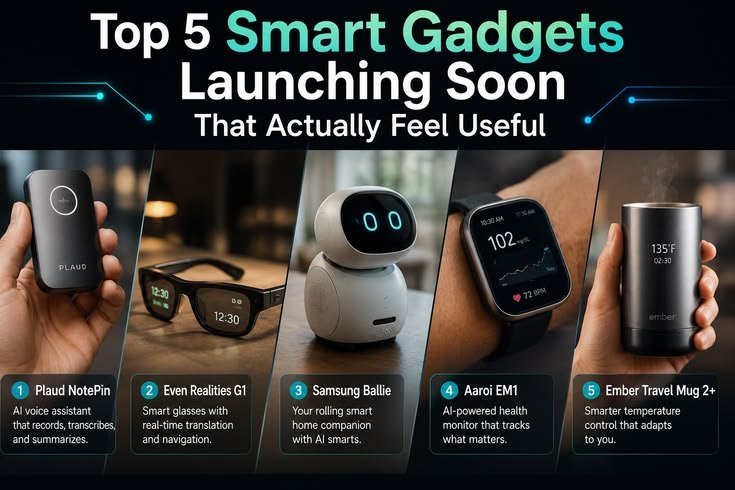



Pingback: Top 5 Smart Gadgets Launching Soon That Actually Feel Useful – MSR Technical