
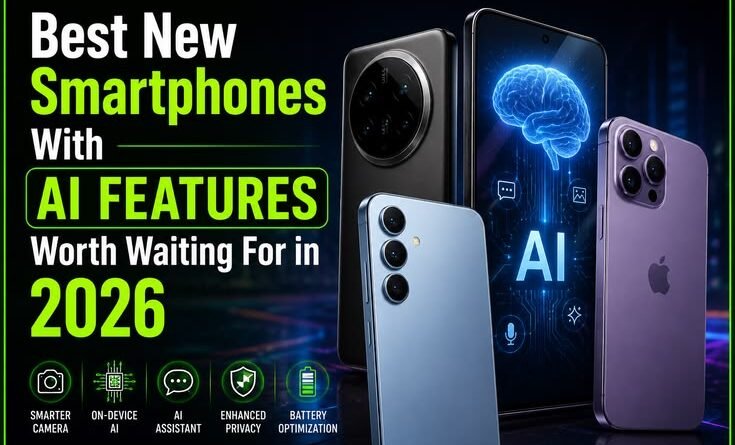
Best New Smartphones With AI Features Worth Waiting For in 2026
My old phone started embarrassing me at a work meeting last year. Right in the middle of trying to record meeting notes, it froze. The person next to me casually pulled out a new Samsung, tapped something called “Live Translate,” and had a real-time conversation with a Korean colleague — no interpreter, no app switching, no awkward pauses. I sat there feeling like I’d shown up to a Formula 1 race on a bicycle.
That moment sent me down a three-month rabbit hole of testing, reading, and honestly — spending way too much time on YouTube watching camera comparison videos at 2 AM. What I found out is that 2026 is genuinely different from the past few years of “AI washing” where companies just slapped a label on features that already existed. The AI on flagship phones right now is actually useful. Not in a demo-stage, “look what it can technically do” way — but in a “this saved me 20 minutes today” kind of way.
So if you’ve been sitting on the fence about upgrading, let me walk you through what’s actually worth your attention — and your money.
The AI Features That Actually Matter (Not Just the Marketing Ones)

Before I get into specific phones, let me save you some time: ignore the spec sheet AI numbers. Companies love to throw around “NPU performance scores” that mean absolutely nothing in real life.
What actually matters is whether the AI does something you’ll use daily. Here’s what I’ve found genuinely useful in 2026:
Real-time translation on calls. This one blew me away. You could be calling a hotel in another country where they don’t speak your language, and AI on smartphones like the Samsung Galaxy S26 can translate the conversation as it happens. Not a garbled approximation — a smooth, real-time back-and-forth. If you travel or deal with international clients, this is a game-changer.
Agentic AI that actually does things. The old AI assistants waited for you to ask. The new ones just… notice things and act. If your phone sees a flight confirmation in your email, it can automatically check the traffic and tell you exactly when to leave. On the Pixel 10, AI might notice you have a meeting at 9 AM and automatically silence notifications while opening your work apps.
On-device processing for privacy. This one matters more than people realize. Many AI features now work offline — you can ask your phone to find a photo from last summer or summarize a PDF, and it does it all without sending your data to the internet.
Smart battery management. Not glamorous, but real. AI features are used to manage how a device’s processor works — and many 2026 flagships pair large batteries with adaptive software that prioritizes foreground tasks and suspends unnecessary background activity. I’ve noticed a solid difference in screen-on time compared to my old phone, which used to die by 6 PM.
Samsung Galaxy S26 Ultra — The Powerhouse That Finally Got Its Act Together
I’ll be honest: I was never a huge Samsung fan because of Bixby. For years, Samsung’s AI assistant felt like a party trick that nobody actually wanted. But the S26 Ultra changes the conversation pretty significantly.
The S26 Ultra’s Galaxy AI runs incredibly well, largely thanks to the super-fast, tailor-made Snapdragon 8 Elite Gen 5 for Galaxy processor. The real-world difference is in how quickly AI-driven tasks execute — things like instant photo editing, search, and translation feel snappy rather than sluggish.
One feature that genuinely surprised me: the Privacy Display. This tech can black out parts of, or the entire screen, hiding personal texts or banking information that you don’t want others around you to see. It sounds gimmicky until you’re on a crowded subway checking your banking app. Then it suddenly makes a lot of sense.
On the camera side, the Galaxy S26 Ultra offers balanced performance across various scenarios, with a wider aperture that enhances light capture, making it a versatile choice for different lighting conditions. The 200MP main sensor gets thrown around as a headline number, but honestly, what makes the camera impressive is the AI processing behind it — not the megapixel count.
The Snapdragon 8 Elite Gen 5 inside the S26 Ultra is built for raw power, offering superior gaming, multitasking, and sustained performance under load. If you’re a heavy user who bounces between apps, edits videos on your phone, or plays demanding games, this is probably the most future-proof Android option right now.
Starting price: Around $1,300 Best for: Power users, multitaskers, people who want the most versatile camera system available
Google Pixel 10 Pro — The AI Phone That Thinks for You
If the S26 Ultra is a Swiss Army knife, the Pixel 10 Pro is a scalpel. It doesn’t try to do everything — it does the things it does extremely well.
Considering that Gemini is basically integrated into every part of the phone, the Pixel 10 Pro is arguably the top AI choice by default — and it’s also the best phone Google has ever released.
The camera is where things get interesting. Google leans heavily on software and AI — computational photography makes everyday photos look polished with minimal effort, and night photography and portrait mode remain strong suits. I tested low-light shots side by side with the S26 Ultra and honestly, the Pixel 10 Pro XL is still the low-light photography champion — Night Sight is excellent, and it’s hard to duplicate the crispness and color accuracy in nighttime images.
The software experience also feels more intuitive. Material 3 Expressive on the Pixel 10 Pro XL is more intuitive and playful, and extras like Now Playing along with recent changes to At a Glance give Google a slight edge in day-to-day usability.
One thing worth knowing: if you’re buying your first Android phone, the Pixel 10 Pro XL is easier to get into — it feels more intuitive and you’ll have an easier time using it from day one.
Starting price: Around $1,000 Best for: First-time Android users, photography enthusiasts, people who want clean and effortless AI
iPhone 17 Pro Max — Apple Does AI Its Own Way
Apple took longer to get into the AI game publicly, but the iPhone 17 Pro Max shows they weren’t sitting still.
Apple remains the industry benchmark for smartphone video — the iPhone 17 Pro Max produces consistently smooth, color-balanced footage with professional-grade stabilization. If you create content, make YouTube videos, or just want your holiday clips to look cinematic without much effort, the iPhone still leads here.
Apple Intelligence continues to prioritize on-device processing, which appeals to privacy-conscious users. The integration across the ecosystem is seamless — if you have a MacBook, iPad, and AirPods, everything talks to each other in a way that Android still struggles to match.
The trade-off? If you already live inside Apple’s ecosystem and care deeply about video quality, the iPhone 17 Pro Max is the clear choice — but if you want to step outside Apple’s walled garden, it becomes a harder sell at the same price point.
Starting price: Around $1,199 Best for: Existing Apple ecosystem users, video creators, privacy-focused buyers
Budget Pick That Surprised Me: Nothing Phone 3a
Not everyone needs to drop $1,000+ on a phone. Here’s something I didn’t expect to be impressed by: the Nothing Phone 3a.
The Nothing Phone 3a costs a quarter of the other phones on this list but has raced ahead with a clever AI-powered central hub that stores and sorts all your notes, screenshots, and saved links — like a smart scrapbook for the 2020s.
It’s not going to out-camera a flagship, but if you want a phone that uses AI in genuinely creative, useful ways without requiring a second mortgage, it’s worth serious consideration.
Common Mistakes People Make When Buying AI Phones
I made a few of these myself, so learn from my pain:
Chasing the NPU score. Raw AI processing benchmarks barely translate to real-world use. Focus on which specific AI features you’ll actually use daily.
Buying for features you’ve seen in ads. Some of the flashiest AI demos are features you’ll use twice and forget. Real-time translation? Daily. AI-generated “artistic” photo styles? Probably not.
Ignoring software update commitments. AI features improve dramatically through software updates. Most major brands now offer around three to five years of OS and security updates, often rolling out new AI features during that window. Google Pixel tends to get new features first.
Assuming more megapixels = better AI photos. Megapixel counts don’t count for much if the sensor sizes are smaller and the lenses are poor quality — digital image processing and camera AI play a big part, and can actually make up for weaker hardware.
Not testing the ecosystem fit. The best AI phone for someone deep in Google’s ecosystem is probably the Pixel. For someone with an Apple Watch and MacBook, it’s the iPhone. The hardware is almost irrelevant if the software doesn’t match your life.
So What Should You Actually Buy?
Here’s the honest breakdown:
- Want the most powerful Android with every AI feature imaginable? Galaxy S26 Ultra.
- Want the cleanest AI experience with the best low-light camera? Pixel 10 Pro.
- Already in Apple’s world and love making videos? iPhone 17 Pro Max.
- Want something genuinely smart without spending a fortune? Nothing Phone 3a.
The smartphone market in 2026 is no longer about dramatic hardware leaps — it’s about refinement. The best phone for you is the one that fits your digital life, not the one with the highest spec sheet.
That lesson took me months to learn. I almost bought the wrong phone twice because I was dazzled by benchmark numbers instead of thinking about how I actually spend my day. Now that I’ve gone through the whole process, the biggest piece of advice I can give you: think about the three things you do most on your phone, then pick the device that does those three things best.
The AI is good enough across the board now that you won’t be disappointed. The differences are in the details — and the details are worth paying attention to.





Pingback: How Google DeepMind’s Lyria 3 AI Tool Can Create Music From Simple Text Prompts
Pingback: The Most Futuristic Products Revealed by Tech Companies This Year