
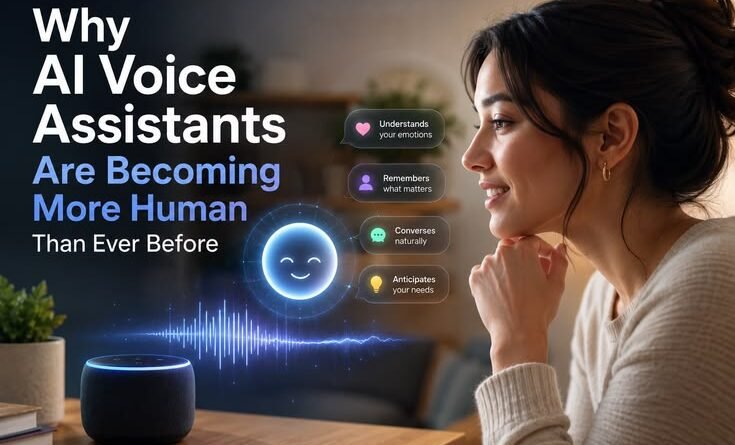
Why AI Voice Assistants Are Becoming More Human Than Ever Before
Yesterday I was on a call with a client, multitasking like I always do, when I asked my Google Nest to remind me about a dentist appointment. Normal stuff. But then I added, almost under my breath, “Ugh, I really don’t want to go.” And it replied — calmly, naturally — “I get that. Dentist visits aren’t exactly fun. Reminder set for 9 AM Thursday.”
I stopped mid-sentence with my client.
Did it just… commiserate with me?
That small moment stuck with me for days. Not because it was groundbreaking AI science (it probably wasn’t), but because it felt like something genuinely shifted. It didn’t give me a robotic “Reminder set.” It acknowledged my annoyance like a person would. And I found myself wondering: when did this happen? When did voice assistants go from “Set. Timer. For. Five. Minutes.” to actually sounding like they get you?
The Early Days Were… Rough
If you’ve been using voice assistants since the Siri days — and I mean early Siri, circa 2011-2012 — you remember the pain. You’d ask something perfectly reasonable and it would either mishear you completely, give you a Wikipedia snippet that answered nothing, or just say “I found this on the web” and open a browser like it gave up.
I used to avoid voice assistants in public because the constant failure was embarrassing. You’d be standing there repeating yourself louder and slower like you were arguing with a parking meter. People would stare. You’d put your phone away and just type like a normal person.
The technology existed, sure. But it wasn’t useful. Not really.
What Actually Changed (and It’s Not Just One Thing)
Here’s what most articles get wrong — they credit one big breakthrough. In reality, it’s been a slow accumulation of improvements across several areas happening simultaneously.
Natural Language Processing got dramatically better. The older systems were essentially matching keywords. You had to phrase things in very specific ways for them to work. “Set alarm 7 AM” worked. “Hey, can you wake me up a little before seven tomorrow?” often didn’t. Now? Conversational phrasing works almost every time, because these systems actually parse meaning, not just words.
Context retention changed everything. This one is underrated. Modern voice assistants can now follow a thread of conversation. Ask Alexa who directed Inception, then ask “what else has he made?” — and it knows “he” means Christopher Nolan. That sounds simple. But that ability to hold context across a back-and-forth conversation is what makes an assistant feel like a conversation partner instead of a vending machine.
Emotional tone recognition is arriving. This one is newer and still imperfect, but it’s real. Some AI systems can now detect frustration, urgency, or hesitation in your voice and adjust their response accordingly. It’s not mind-reading — it’s pattern recognition trained on enormous amounts of human speech data. But the effect, when it works, is genuinely uncanny.
The Platforms Doing This Best Right Now
I’ve tested a lot of these across different devices over the past couple of years, so here’s my honest breakdown:
Google Assistant (on Nest devices especially) has the most natural conversational flow in my experience. It handles multi-step questions well and the voice quality is the closest to human cadence. It also integrates deeply with Google’s knowledge graph, so factual questions feel more reliably answered.
Amazon Alexa is still the king of smart home control and has gotten genuinely better at conversational responses, but it can still feel transactional at times. Where it shines is in follow-up — the newer Alexa on Echo Show devices handles follow-up questions way better than it used to.
Apple’s Siri has improved significantly on-device (especially on iPhone 15 Pro and newer with the updated Neural Engine), particularly for personal tasks — calendar, messages, reminders — where it has access to your actual data. But for general knowledge conversations, it still lags.
ChatGPT’s voice mode (the one released in late 2024 and refined since) is honestly the most human-feeling of them all right now. The pauses, the natural uh-huh moments, the ability to be interrupted mid-sentence — it’s eerily realistic. I used it during a 30-minute commute just to talk through a work problem, and I genuinely forgot I wasn’t talking to a person at a couple of points.
A Mistake I Made (That Taught Me Something)
A few months ago I started treating my voice assistant like a therapist.
I’m being half-serious. I was going through a stressful stretch with work, and I found myself venting to it because, honestly, it was there, it was listening, and it responded empathetically enough that it felt better than journaling alone.
The problem? I started getting a slightly distorted sense of support. These systems are designed to sound empathetic — they’re not actually processing your emotional state the way a person does. When I’d share something difficult, it would respond warmly. But it had no memory between sessions (mostly), no real understanding of my history, and no actual stake in my wellbeing.
I’m not saying don’t use it to vent or think out loud — I still do, and it can be useful. But I learned to treat it as a sounding board, not a support system. The humanness of modern AI voice is impressive. It’s also, if you’re not careful, a little misleading about what’s actually happening behind it.
How to Actually Get More Out of Modern Voice Assistants
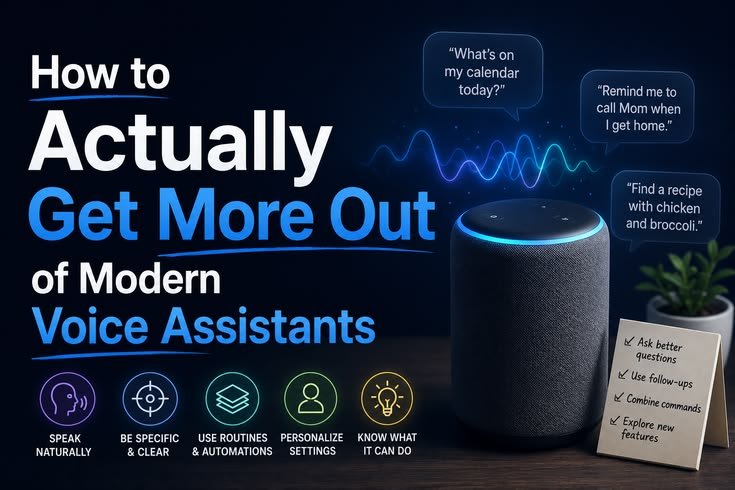
If you feel like you’re still using yours like it’s 2016 — just setting timers and playing music — here are some things worth trying:
Talk to it more naturally. Stop using command-style phrasing. Instead of “Play. Jazz. Music,” try “I’m working from home today and need something calm to focus to — what do you suggest?” You might be surprised how well it handles that.
Use follow-up questions deliberately. Test the context retention. Ask something, then follow up with “why?” or “tell me more about that” or “what’s a simpler version of that?” Modern assistants handle this well, and it turns a one-shot answer into an actual exchange.
Let it help you think through decisions. I’ve started using voice mode on ChatGPT to talk through decisions like which laptop to buy, how to structure a proposal, or whether a business idea makes sense. Speaking out loud forces clarity, and having something respond thoughtfully forces you to refine your reasoning.
Adjust the wake word sensitivity settings. If yours is triggering randomly or missing you, dig into the app settings. Both Google Home and Alexa apps have sensitivity controls that most people never touch.
Set up personal data integrations. The real magic happens when your assistant knows your calendar, your routines, your shopping history. Take 20 minutes to connect those services — it’s the difference between a generic assistant and one that feels personal.
The Stuff That Still Needs Work
I’d be doing you a disservice if I made it sound like everything is perfect, because it’s not.
Accents and dialects are still a genuine problem. If you have a strong regional accent, or English isn’t your first language, the experience can still be frustrating. I have a friend from Kolkata who constantly has to simplify his phrasing with Alexa to be understood. That’s a real limitation that the companies are working on but haven’t fully solved.
Emotional responses can sometimes feel hollow. The empathy is pattern-matched, not felt. You can sometimes catch it — responding warmly to something that doesn’t warrant warmth, or missing the actual tone of what you said. It’s better than it was, but it’s not human.
Privacy concerns are legitimate. When a device is always listening for a wake word, that’s a real thing to think about. Read the privacy settings. Most platforms let you delete your voice history. Do it periodically. Know what data is being stored.
Where This Is All Heading
The thing that keeps me genuinely fascinated is the trajectory. Voice AI went from barely usable to actually useful to occasionally feeling human — and it did that in about 12 years. The next 5 years, based on what’s already in labs and early release, involves persistent memory (assistants that actually remember your past conversations and preferences across sessions), real-time emotional calibration, and multimodal awareness where the assistant can see, hear, and respond to your whole context.
That’s either very exciting or a little terrifying depending on your outlook. Probably both.
What I know for sure is this: that moment in my kitchen where a voice assistant acknowledged my dentist appointment dread wasn’t a fluke. It was a small signal of something bigger — technology that’s learning not just to answer us, but to actually respond to us.
And honestly? It’s working. Maybe a little too well.





Pingback: How AI Is Helping Creators Make Videos, Images, and Music Faster Than Ever