
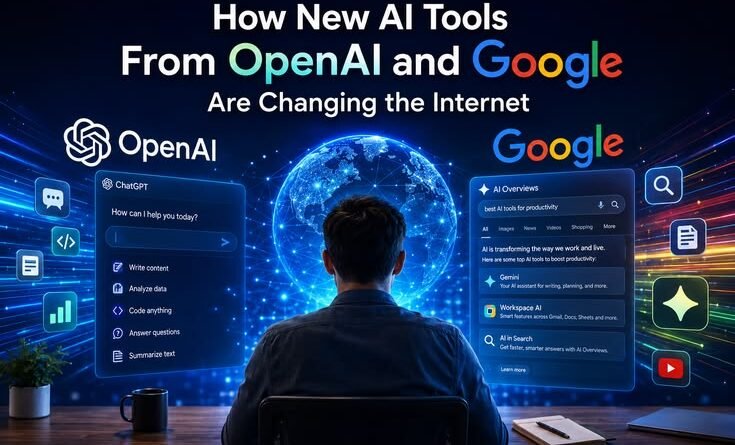
How New AI Tools From OpenAI and Google Are Changing the Internet
A few months back, I was helping a friend set up a simple blog. She’d spent weeks writing detailed “how-to” guides — solid stuff, genuinely useful advice. We were excited. Then we checked her traffic after a couple of months and discovered most of her best posts were getting almost zero clicks, even though she was ranking on page one of Google.
The culprit? Google had started slapping AI-generated answer boxes right at the top of search results. Users were reading the answer there and never scrolling down to her site.
That was my real introduction to just how aggressively AI tools from Google and OpenAI are rewiring the internet — not in some distant future, but right now, in ways that affect everyday people, creators, and businesses. I’ve spent the last several months digging deep into these tools, and I want to share what I’ve actually experienced, what surprised me, and what you should probably know.
The Search Engine You Grew Up With Is Already Gone
Let’s start with Google, because most people still think of it as a search engine. That’s not really what it is anymore.
Google’s AI Overviews — those big AI-generated summary blocks at the top of results — now appear in roughly one in four searches in the US. For informational questions (the “how does X work” or “what is the best way to Y” type), they show up nearly 40% of the time. Google’s own data shows over a billion people are using AI features every month.
Here’s the uncomfortable reality that took me a while to fully absorb: when Google shows an AI Overview, users click organic links at roughly half the rate they used to. One major study across 68,000 real queries found click rates dropped from 15% to 8% the moment an AI Overview appeared. For publishers, bloggers, and small businesses who built their audience on Google traffic, this is genuinely disruptive — not a distant worry, but an active squeeze on their revenue right now.
I watched it happen to my friend’s site in real time. Her “best” ranking posts were now information sources for Google’s AI, not destinations in themselves.
What OpenAI Has Been Doing to the Address Bar
While Google remade search, OpenAI has been quietly replacing a completely different habit: the act of looking something up.
I remember the first time I genuinely stopped going to a specific website for information and just asked ChatGPT instead. It was a recipe site. I’d always gone there for reliable cooking instructions. Then one day I just asked, “How do I make a proper risotto?” and got a better answer, faster, with no ads, no pop-ups, no life story before the recipe.
That’s the shift. And it’s accelerating.
OpenAI released GPT-5.5 in late April 2026, and the framing from the company was unusually direct: this isn’t a smarter chatbot. It’s designed to function as an agent — something that takes a messy, multi-step task, plans it out, uses tools, checks its own work, and follows through. You can give it something like “research three competitors in my space, summarize their pricing, and put it in a comparison doc” and walk away.
GPT-5.5 also ships with a revamped Shopping mode — side-by-side product comparison with structured cards that deep-link into retailer checkout, covering Amazon, Best Buy, Walmart, and Target at launch. It’s the first time a chatbot has done what Google Shopping promised over a decade ago but never quite delivered.
A lot of what I’ve seen called “the death of the traditional web” is really just this: people are increasingly comfortable starting their internet experience in a chat interface rather than a search bar.
The Agents Are Here. They’re Just Awkward Right Now.
One thing I’ve learned the hard way: these AI agent features are genuinely useful but still rough around the edges.
Last winter, I tried using a then-early version of ChatGPT’s agent mode to do market research for a small project. I asked it to compile pricing data from five SaaS tools, pull together their feature lists, and give me a written comparison.
It did most of it. But it also hallucinated a pricing tier for one tool that didn’t exist and grabbed outdated info from a page that hadn’t been updated in two years. I nearly included that wrong data in a document I was about to share.
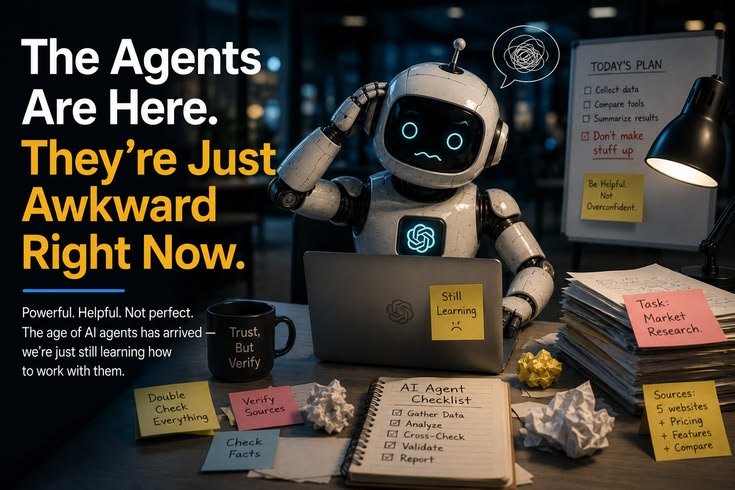
Lesson learned: treat AI agents like a smart but occasionally overconfident intern. They save you enormous time, but you have to check their work — especially for anything involving specific facts, prices, or figures.
The good news is these tools are improving fast. GPT-5.5’s approach to agentic tasks is noticeably more careful than what I tested six months ago. It’s better at flagging when it’s uncertain, and its hallucination rate on factual tasks has measurably dropped, particularly in law, medicine, and finance use cases.
Google’s Own AI Race Is Quieter But Deeper
OpenAI gets more press, but Google’s AI push is arguably more structurally significant because Google owns the infrastructure the internet runs on.
At Google Cloud Next ’26, the company launched what it’s calling the Gemini Enterprise Agent Platform — essentially a system for businesses to deploy AI agents connected to their internal data, customer systems, and Google’s cloud tools. At the same event, they announced their eighth-generation TPUs, chips specifically designed for the “agentic era.”
For consumers, Google has been baking Gemini into everything: Gmail, Google Docs, Search, Chrome. Deep Research Max is now available for advanced data analysis. Learn Mode in Colab turns Gemini into a personalized coding tutor. Google Translate crossed one billion users and now handles a trillion words per month.
What Google has that OpenAI doesn’t is integration. When Gemini lives inside Gmail, Docs, and Search simultaneously, it’s not competing for your attention — it’s already inside the workflows you already use.
What’s Actually Changing for Regular People
Here’s the practical breakdown of how this lands in real life:
How you find information: You’re increasingly likely to get an answer without clicking anywhere. That’s convenient, but it also means you’re trusting AI to summarize sources accurately — and it sometimes gets things wrong or out of date.
How you shop: ChatGPT now lets you compare products side by side and link directly to checkout. Google has embedded shopping into AI Mode. The product review blog you used to read before buying? It’s being squeezed from both sides.
How you get work done: If you’re a knowledge worker — writing, researching, coding, planning — these tools are genuine productivity multipliers. I’ve personally cut my research time for articles like this one by more than half. But the ceiling requires knowing when to trust the output and when to verify it.
How websites get traffic: If you run a website or blog, the old playbook of ranking for informational keywords is in serious trouble. The sites that are surviving are those earning citations inside AI Overviews — which actually drives a CTR increase of up to 35% for the cited sources. Getting picked as a source the AI trusts is the new page-one ranking.
The Mistakes I See People Making Right Now
1. Treating every AI output as gospel. I’ve seen people publish AI-generated content without reading it, share AI research without verifying sources, and make business decisions based on hallucinated data. It’s happening constantly. These tools are assistants, not oracles.
2. Panicking about SEO and doing nothing. Yes, the old rules are broken. But the new rules are becoming clearer. Content that earns AI citations — structured, authoritative, specific — is actually performing better than ever.
3. Using the wrong tool for the job. GPT-5.5 is excellent for long, complex tasks and coding. Gemini lives inside Google’s ecosystem and is better when you need real-time information woven into existing workflows. Perplexity is faster for quick fact lookups with citations. Using just one for everything means leaving real value on the table.
4. Ignoring the agentic shift. The biggest change isn’t smarter chatbots. It’s AI that takes actions — booking things, writing and sending emails, running code, browsing the web on your behalf. Most people haven’t seriously experimented with this yet. The people who figure it out early are going to have a significant edge in whatever their field is.
What I Think Happens Next
The honest answer is nobody fully knows. Even the people building these tools are surprised by how fast they’re evolving.
What I’m watching closely: The line between “AI assistant” and “AI that does things for you” is blurring fast. GPT-5.5 is framed as an agent. Google’s Gemini Enterprise platform is explicitly agentic. The infrastructure connecting AI to real tools — databases, APIs, calendars, inboxes — is rapidly standardizing.
The internet isn’t dying. But the habits that defined it for twenty years — type a search query, get a list of links, click through, find your answer — are being replaced. You’re increasingly going to describe what you want, and an AI will navigate the internet on your behalf.
For creators, that’s a challenge worth taking seriously now, not later. For consumers, it’s mostly a superpower — if you learn to use it without becoming completely dependent on it.
My friend with the blog? She pivoted. She stopped writing generic how-to posts and started writing deeply specific, experience-based content that AI tools can cite but can’t replicate. It’s working. Her traffic is back up, coming from different channels than before, and she says the work is actually more interesting now.
That feels like the right metaphor for where we are. Things changed. You can adapt or wait. But the tools are moving whether you’re watching them or not.
Updated May 2026. All data and features referenced reflect the current state of these tools as of this writing.



Pingback: Top New Smartphone Camera Technologies That Could Change Mobile Content Creation
Pingback: Why AI Voice Assistants Are Becoming More Human Than Ever Before
Pingback: How New AI Agents Are Automating Customer Support and Business Workflows
Pingback: How Microsoft Is Bringing AI Features Into Windows and Office Apps Faster Than Ever
Pingback: Best New Smartphones With AI Features Worth Waiting For in 2026 – MSR Technical
Pingback: Top 5 Smart Gadgets Launching Soon That Actually Feel Useful – MSR Technical