
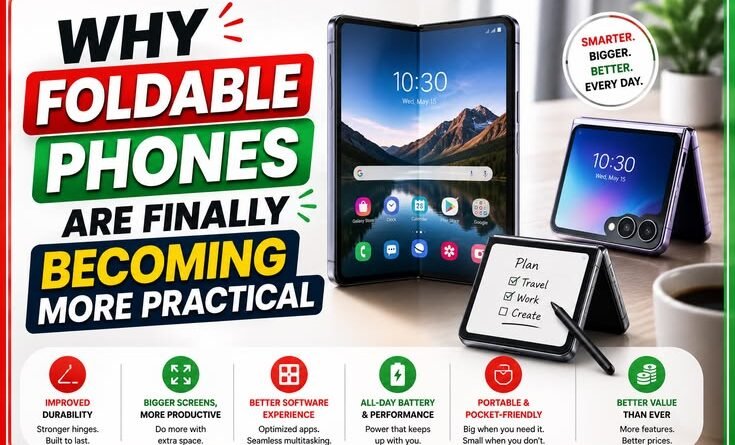
Why Foldable Phones Are Finally Becoming More Practical
By a tech blogger who bought one too early and paid the price
still I remember unboxing my first foldable phone back in 2021. It was the Samsung Galaxy Z Fold 3 — beautiful, futuristic, and expensive enough that I skipped buying a laptop that year. Three weeks later, the crease on the inner display was bothering me so much I started using it folded-closed 90% of the time. I’d essentially paid ₹1,50,000 for a slightly thick regular phone.
That’s when I realized foldables weren’t ready — I was just early.
Fast forward to today, and my daily driver is a Galaxy Z Fold 6. The difference is night and day, and not in the way I expected. It’s not about the screen getting better (though it did). It’s that everything around the device — the software, the apps, the ecosystem — finally caught up to the hardware. And that’s what nobody talks about enough.
The Real Problem Wasn’t the Hardware
When foldables first launched, every review focused on the same things: the crease, the hinge durability, the price. Those were valid concerns, but they weren’t the actual daily frustration.
The real problem? Apps had no idea what to do with a big screen.
Open Instagram on an early foldable in tablet mode and you’d get a stretched, pixelated mess that looked like someone sat on your phone. Gmail would show one giant column like a newspaper column in a hall. YouTube would have black bars so thick the actual video was smaller than on a regular phone.
I tested this obsessively. I kept a spreadsheet (yes, really) of which apps worked properly in unfolded mode and which ones didn’t. Out of 40 apps I used regularly, only 11 were actually optimized for the larger screen. That’s roughly 27%. The rest? You were better off keeping the phone folded.
That’s not a hardware problem. That’s a software and developer ecosystem problem.
What Actually Changed
Google got serious about large-screen optimization somewhere around Android 12L, and the ripple effect has been gradual but real. They started requiring apps on the Play Store to declare large-screen support and pushed developers to test across different form factors. Samsung layered their own “Flex Mode” improvements on top, splitting apps into dual-pane views that actually make sense.
Here’s what’s noticeably better now compared to three years ago:
1. Multitasking finally works like it should
On the Z Fold 6, I regularly run three apps simultaneously — my notes app on one side, a browser in the middle, and a YouTube video floating in a corner. I’m not doing this to show off. It’s genuinely how I work now. When I’m researching for an article, I can read a source, take notes, and watch a walkthrough video at the same time, without a laptop.
The drag-and-drop between apps has gotten smooth too. I can pull an image from Chrome and drop it directly into a WhatsApp chat. Small thing, massive quality-of-life improvement.
2. The crease is still there, but you stop caring
This is going to sound like I’m making excuses for Samsung, but hear me out. The crease on the Z Fold 6’s inner display is significantly less visible than on the Fold 3, and more importantly, your brain adapts. After a week of daily use, I genuinely stopped noticing it. It’s like the notch on old iPhones — everyone complained for a year, then collectively forgot it existed.
What helped was the display getting brighter. Outdoor visibility used to make the crease more visible. Now, even in Jodhpur’s summer sun, the display holds up well enough that the crease doesn’t catch the light the same way.
3. The outer screen is no longer an afterthought
Early foldables had outer screens that were comically narrow. The original Galaxy Z Fold had a cover screen so thin you needed the dexterity of a surgeon to type on it. The Z Fold 6’s outer screen is wide enough to use comfortably one-handed — actually comparable to using a regular phone. This matters because most of your quick tasks (checking notifications, replying to a message, paying via UPI) don’t require unfolding. The outer screen handles them fine.
The Flip Side Is Even More Practical (Literally)
I want to give the clamshell foldables — the Galaxy Z Flip 6, the Motorola Razr+ — their due credit here, because I think they’re actually the sleeper hit of the foldable category.
My colleague switched from an iPhone 14 to a Z Flip 6 and her reasoning was surprisingly practical: she hated how big phones had gotten. A regular flagship these days is enormous. The Flip folds down to a size that fits in a jeans pocket without creating that rectangular brick silhouette. When unfolded, it’s a full-size phone with a proper tall screen.
Her cover screen use case? Flex Mode camera. She props the phone half-open on a table, bottom half acts as a stand, and uses the top half as a viewfinder. Hands-free video calls, hands-free filming. It’s a genuinely useful feature she uses daily, not a gimmick she tried once at the store.
Mistakes I Made (So You Don’t Have To)
Buying the first model of anything foldable. Generation 1 and 2 of foldables were for enthusiasts who accept rough edges. If you’re buying a foldable now, you’re buying something that’s had several hardware revisions. Don’t try to go back and snag a “deal” on an older model — the hinge improvements alone on newer generations are worth the price difference.
Putting it in the same pocket as keys. The inner display is protected when folded, but the outer screen is exposed. Got a hairline scratch within the first month on my Fold 3 from pocket debris. Use a case, or at minimum, be mindful of what’s in your pocket.
Expecting every app to just work. Check beforehand if your essential apps support large-screen layouts. For most people, the critical ones — Chrome, Maps, YouTube, WhatsApp, most productivity apps — are fine now. But if you use niche apps, test them first.
Ignoring the weight. The Z Fold 6 weighs around 239 grams. That’s noticeably heavier than a regular phone. If you’ve got wrist issues or hate heavy devices, this matters more than you’d think after a full day of use.
Who Should Actually Buy One Right Now
Here’s my honest take, after years of daily use:
Foldables make sense for you if:
- You consume a lot of content on your phone (videos, articles, books)
- You work from your phone more than occasionally
- You’re tired of carrying both a phone and a tablet
- You take a lot of photos and want the flex-stand camera trick
- You want to stand out (valid reason, honestly)
They probably don’t make sense if:
- You’re extremely rough on your devices
- Your budget is tight — the price premium is real
- You use very niche apps that likely haven’t been optimized
- You prioritize having the thinnest, lightest device possible
The Price Problem Is Slowly Solving Itself
A Galaxy Z Fold 6 starts around ₹1,64,999 in India as of now. Still expensive. But compare that to where the category started — the original Galaxy Fold launched at over ₹1,90,000 — and the trend is clear. Prices are coming down as manufacturing scales up.
More importantly, competition is heating up. OnePlus has the Open. Google released the Pixel 9 Pro Fold. Motorola is aggressively pricing its Razr lineup. Competition does what competition always does — it pushes quality up and prices down.
The mid-range foldable, around ₹70,000-80,000, is probably two or three years away. When it lands, this category goes mainstream.
One Thing That Still Annoys Me
Battery life. I’ll be straight — a full day of heavy use on the Z Fold 6 with the inner screen on for extended periods will have you reaching for a charger by evening. It’s not terrible, but it’s not the all-day powerhouse you get from a regular flagship at this price. If you travel a lot without access to charging, keep a power bank in your bag.
Where This Is All Headed
The reason foldables feel more practical now isn’t one single breakthrough. It’s a hundred small improvements arriving at the same time — better hinges, optimized software, improved displays, developer support, smarter outer screens — and they’ve collectively crossed a threshold where the device finally serves the user rather than the user serving the device.
Three years ago, I was adapting my habits to the phone’s limitations. Now, the phone is adapting to my habits. That’s the whole point, and it’s taken until roughly 2024-2025 to actually get there.
If you’ve been curious but kept waiting for foldables to “get good,” I’d say they’re good now. Not perfect — but genuinely good. And that’s a sentence I couldn’t have written with a straight face even two years ago.
Have questions about specific foldable models or use cases? Drop them in the comments — I check them regularly and try to respond to everyone.



Pingback: Why Foldable Phones From Samsung, OnePlus, and Honor Are Becoming More Popular Again
Pingback: How AI Is Helping Creators Make Videos, Images, and Music – MSR Technical