
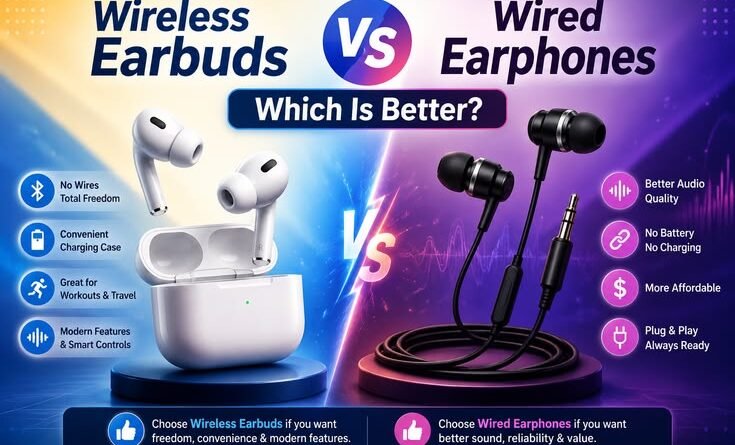
Wireless Earbuds vs Wired Earphones — Which Is Better?
Wireless Earbuds vs Wired Earphones — I Switched Back and Forth So You Don’t Have To
Last year, I lost my third pair of wired earphones in six months. Not lost as in misplaced — lost as in the left earbud just… died. Gave up. Went silent mid-song during my morning run. At that point, I did what most people do: I ordered a pair of wireless earbuds thinking I’d finally solved all my audio problems forever.
Spoiler: I hadn’t.
Here’s what I’ve actually learned after living with both, sometimes simultaneously, and why this debate is way more nuanced than any spec sheet will tell you.
The “Just Go Wireless” Trap
When I switched to true wireless earbuds — a pair of Sony WF-1000XM5s, which I saved up for — I thought I was entering audio heaven. No tangled cables around my neck. No accidental yanks that send my phone flying off a table. Pure freedom.
And for the first two weeks? It genuinely was great.
Then real life happened.
I forgot to charge them one night, grabbed them in the morning for my commute, and sat in dead silence on a 45-minute bus ride because both buds had 0% battery. I tried to use them wired in the meantime — oh wait, no 3.5mm jack on my phone anymore. Just sat there like an idiot staring out the window.
That was lesson one: wireless earbuds demand a level of daily discipline that nobody warns you about.
Where Wired Earphones Still Win — Honestly
I still keep a pair of wired earphones in my laptop bag. My current go-to is the SoundMagic E11C, which costs around ₹1,500 and sounds embarrassingly good for the price.
Here’s where wired just doesn’t mess around:
Zero latency. If you edit videos, record podcasts, or do any kind of audio work on a laptop, you already know that even a 50ms Bluetooth delay is maddening. Wired gives you what you hear, exactly when it happens. No processing, no codec negotiation, no drama.
Always ready. Plug in. Done. There’s something underrated about a tool that works 100% of the time without a charging ritual.
Durability over time. Yes, wires break — but they usually break at the same two spots (the jack and where the cable meets the bud). That failure is predictable. With wireless earbuds, battery degradation is invisible and inevitable. After 18 months, the battery life on my Sonys had already dropped noticeably. That’s not a defect; that’s just lithium-ion chemistry doing what it does.
Sound quality per rupee. For the same ₹2,000, a wired earphone almost always sounds better than a wireless one. Bluetooth audio compression (even with aptX or LDAC) still involves encoding and decoding. At budget price points, wired wins the sound quality war without even trying hard.
Where Wireless Earbuds Are Genuinely Superior
That said, I’m not going back to wired for everything. There are situations where wireless earbuds are so much better that it’s not even a fair comparison.
Working out. Running with a wire bouncing against your chest is annoying in a way that slowly makes you hate exercise. I switched to wireless for gym and outdoor runs and never looked back. Sweat resistance (look for IPX4 or higher) plus no cable equals a genuinely more enjoyable workout.
Active Noise Cancellation. Good ANC on wireless earbuds is still a superpower. On a loud flight, a busy café, or a chaotic open-plan office, flipping on ANC feels like someone turned the volume of the world down three notches. Wired earphones with ANC exist but they’re rare, bulky, and expensive.
Calls and video meetings. Modern wireless earbuds have gotten scary good at isolating your voice. The mic on my Sony WF-1000XM5s handles wind, background noise, and ambient chaos better than most laptop microphones. For remote workers who live on Zoom or Google Meet, this is genuinely useful.
Freedom of movement. If you cook, pace around while thinking, or do housework while listening to podcasts, wireless is just more practical. The tether of a cable becomes irritating in ways you don’t fully appreciate until it’s gone.
The Battery Thing — Let’s Be Honest About It
Battery anxiety is real and nobody talks about it enough.
With wired earphones, the concept of “will this work?” doesn’t exist. With wireless? You’re managing three batteries — left bud, right bud, and the case — and they don’t always agree with each other. I’ve had my right bud drain faster than the left, which is apparently a known issue with some models and how Bluetooth signal routing works.
What I do now: I charge the case every night the same way I charge my phone. It’s a habit thing. Once it became automatic, the battery anxiety mostly went away. But it took about a month to build that habit, and before that, I ran out of charge at least once a week.
If you’re forgetful — and I mean genuinely forgetful, not just occasionally — wired earphones will cause you less stress in everyday life.
Real Scenarios to Help You Decide

Let me break it down by how you actually use audio gear:
You’re a student in college: Wired earphones. Budget is tight, you’re likely in your room or library most of the time, and you don’t need ANC to pay attention to lectures. Get the KZ ZSN Pro or SoundMagic E11 and spend the rest of your money on chai.
You work from home and attend 4+ video calls a day: Wireless earbuds with good mic quality. The Jabra Evolve2 Buds are built for this, though pricier. Even something like the CMF Buds Pro 2 at ₹2,499 is solid for calls.
You commute via public transport daily: Wireless with ANC, no question. The QCY HT05, Boult Audio AirBass Z40, or if you have more budget, the Nothing Ear (2) — ANC on your commute is a genuine quality-of-life upgrade.
You’re a music purist or audiophile on a budget: Wired. Something like the KZ ZS10 Pro or Moondrop Chu 2 will embarrass wireless earbuds costing three times as much. Audiophiles have known this for years; it’s just not marketable anymore, so nobody says it.
You go to the gym or run outdoors: Wireless, full stop. Specifically look for earbuds with ear hooks or fins for stability, IPX4 or better sweat resistance, and ideally Transparency Mode so you can hear traffic. The Soundcore Sport X20 or Jabra Elite Active 4 are worth checking out.
Mistakes I Made (So You Don’t Have To)
Buying the cheapest wireless earbuds I could find. I spent ₹799 on some no-brand TWS earbuds from an online sale once. The connection dropped every 30 seconds. The sound was hollow. They didn’t even fit properly. Cheap wired earphones are tolerable; cheap wireless earbuds are genuinely painful to use. There’s a minimum price floor for wireless that doesn’t exist the same way for wired.
Ignoring codec support. I once bought earbuds that only supported SBC — the most basic Bluetooth audio codec — and wondered why music sounded flat compared to my wired earphones. Now I check: does this support aptX, AAC, or LDAC? And does my phone support those codecs on its end too? Both sides need to match.
Not checking the return policy before buying. Fit is everything with earbuds, and you can’t know how something fits until it’s in your ear for two hours. I’ve bought earbuds that looked perfect on paper but physically couldn’t stay in my ears during a light jog. Always buy from somewhere with a decent return window.
Assuming more expensive = better for my needs. My ₹1,500 SoundMagic wired earphones still beat my ₹18,000 wireless earbuds for late-night music listening sessions when I’m at my desk. Expensive doesn’t mean universally better — it means better for certain use cases.
The Honest Answer Nobody Wants to Give
There’s no winner. I know that’s frustrating, but it’s true.
If someone asks me what to buy right now, my actual answer is: tell me how you plan to use them.
For active use, commuting, and calls — wireless earbuds are worth the investment and the charging habit. For budget listening, desktop use, audio work, and reliability — wired earphones are still brilliantly relevant and unfairly overlooked.
The audio industry wants you to think wired is obsolete. It isn’t. It’s just less profitable to sell you.
I personally carry both. Wired earphones in my work bag, wireless earbuds on my person. It sounds extra, but honestly? It means I’m never stuck with a bad listening experience, and I spend a lot of time with audio in my ears. That balance works for me.
Figure out where you spend most of your audio time, and let that guide your decision. Trust me, that single question will tell you more than any spec comparison ever will.