
Fast Charging Explained — 33W vs 65W vs 120W What Is Difference
By a guy who has burned through way too many chargers and learned things the hard way.
The Night My Phone Died Before a Flight
Picture this: it’s 11 PM, your flight is at 6 AM, and your phone is sitting at 4%. You plug it in, set your alarm for 4 AM, and pray. You wake up — 47%. That’s it. Five hours of charging and you’re flying out with less than half a battery.
That was me, about three years ago, using the stock 10W charger that came in the box with my phone. I had no idea fast charging was even a serious thing back then. I thought “fast” just meant the wire wasn’t broken.
Fast forward to now: I’ve tested chargers across multiple phones, including a Redmi Note 12 Pro (67W), a OnePlus 11 (100W), a Realme GT Neo 5 (240W — yes, that’s real), and a couple of iPhones. I’ve timed charging sessions, checked heat output, and yes, I’ve made some dumb mistakes along the way.
So let me walk you through what fast charging actually means, and why the wattage numbers you see on the box actually matter in your day-to-day life.
What Does “Wattage” Even Mean in Charging?
Before we compare 33W vs 65W vs 120W, you need to understand one simple thing: wattage is basically the speed of electricity flowing into your battery.
Think of it like filling a bucket with water. A thin pipe (5W charger) fills it slowly. A wider pipe (65W charger) fills it fast. A fire hose (120W+) fills it almost instantly — but only if the bucket can handle that pressure.
The math is: Watts = Volts × Amps
Your phone controls how much wattage it actually accepts. Even if you plug a 120W charger into a phone that only supports 33W, the phone will cap the input at 33W. The charger can’t “force” more power in. So you won’t damage your phone with a more powerful charger (as long as it’s from a reputable brand — more on that later).
33W Charging: The Comfortable Middle Ground
When I got my first phone with 33W charging, I genuinely thought it was magic. Coming from a 10W world, it felt like a superpower.
What 33W looks like in real life:
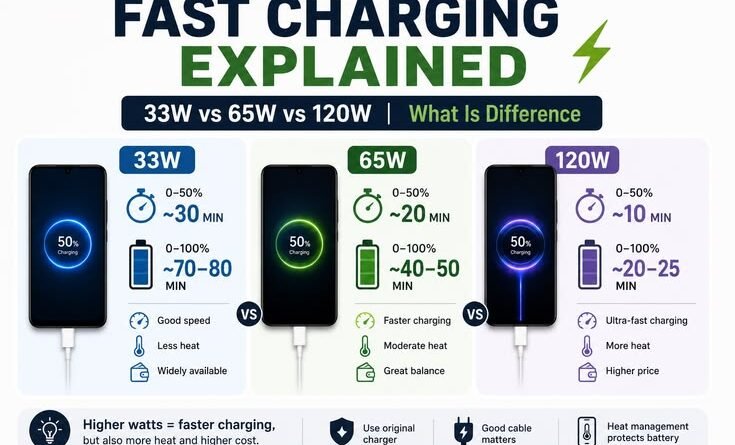
- 0 to 50% in roughly 30 minutes
- Full charge in about 70–80 minutes
- Charger gets slightly warm, but not uncomfortable to touch
- Works well overnight — won’t cause massive heat buildup
33W is currently what you’d call the entry point for real fast charging. Most mid-range phones in 2024–2025 ship with this. It’s fast enough to top up while you’re getting ready in the morning, and it’s not aggressive enough to noticeably stress the battery in normal use.
Who should care about 33W? Honestly, most people. If you’re not a heavy user, 33W is perfectly fine. You can go from 20% to 80% during a lunch break. That covers 90% of use cases.
65W Charging: Where It Gets Genuinely Impressive
This is the wattage level I personally recommend when someone asks me what to look for in a new phone. 65W hits a sweet spot — fast enough to feel genuinely quick, stable enough that it doesn’t run absurdly hot.
Real-world 65W numbers (from my own testing on a Redmi Note 12 Pro):
- 0 to 50% in about 18–20 minutes
- Full charge in 45–50 minutes
- Charger gets noticeably warm, phone gets warm around the charging port
The jump from 33W to 65W is more noticeable than people expect. You’re cutting charge time almost in half. That’s the difference between a full charge during dinner vs. a full charge in the time it takes you to shower and get dressed.
One thing I noticed: at 65W, most phones implement a two-stage charging system. The first 80% charges at full speed, then it throttles down for the last 20% to protect the battery. That’s why charging from 80% to 100% always feels slower — it’s intentional.
120W Charging: Borderline Absurd (In a Good Way)
The first time I used a 120W charger on a compatible phone, I genuinely stood there and watched the percentage tick up in real-time. It almost felt like a party trick.
What 120W looks like in practice:
- 0 to 50% in about 10–12 minutes
- Full charge in 20–25 minutes
- Phone and charger get noticeably hot — sometimes uncomfortably so
- Battery protection systems kick in hard after 80%
The OnePlus 11 I tested with its 100W SUPERVOOC charging went from dead to 100% in about 32 minutes. The phone was warm — not hot enough to alarm me, but you’d definitely feel it if you were holding it during charging.
The companies pushing 120W+ include Xiaomi (with its HyperCharge), Realme, and OPPO/OnePlus. They’ve invested heavily in custom battery cell technology to make this work without destroying batteries within a year.
The Part Nobody Talks About: Heat and Battery Longevity
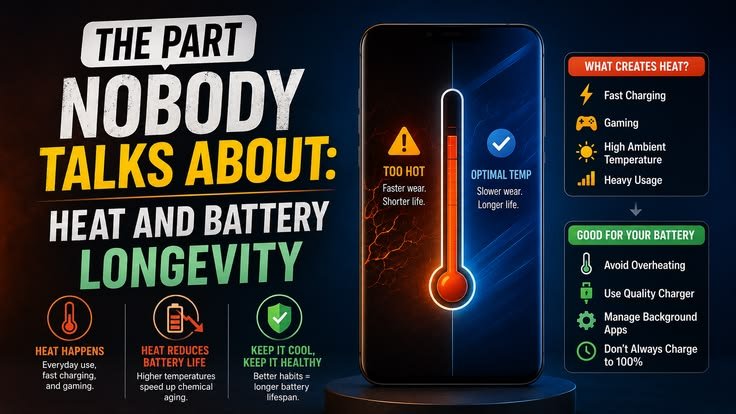
Here’s something most review sites gloss over: heat is the enemy of battery health.
Every time your battery charges, it degrades slightly. Heat accelerates that degradation. A battery that regularly charges at extreme temperatures will show capacity loss sooner than one kept cooler.
Manufacturers who ship 120W charging aren’t ignoring this — the good ones split the battery into two cells charged simultaneously (so each cell only “sees” half the stress), add dedicated charging chips, and use algorithms to monitor temperature constantly.
But here’s my personal observation after 18 months of using a 67W phone: my battery health sits at around 91%, which is decent but not amazing. Compare that to my iPhone 14 (18W charging), which is at 97% after similar usage. The slower charging iPhone wins on battery longevity. That’s just the reality.
My rule of thumb:
- If you charge once a day and keep the phone 2–3 years: go for 65W max, avoid 120W daily
- If you’re always upgrading every year or two: don’t worry about it, use whatever’s fastest
Common Mistakes People Make With Fast Charging
I’ve made most of these myself, so no judgment.
1. Buying cheap third-party chargers This is the big one. A $4 charger from a random Amazon listing claiming “65W Fast Charge” is not the same as the one that came in the box. These unverified chargers skip safety protections and can damage your battery, or worse — they’ve been known to cause fires. Spend the extra money on brands like Anker, Baseus (their premium line), or official OEM chargers.
2. Using any cable with a fast charger A USB-A to Micro-USB cable from 2016 is NOT going to deliver 65W. You need a USB-C cable rated for the wattage you’re targeting. Look for USB-C cables rated at 60W or 100W (there’s usually a “60W” or “5A” printed somewhere on the cable or packaging). The braided Anker cables are solid and cheap.
3. Charging in a hot environment Charging your phone at full speed inside a car on a summer afternoon is genuinely bad for the battery. The ambient heat stacks with the heat generated by charging. Charge in a cool, ventilated spot when possible.
4. Expecting fast charging specs to match real-world performance If a brand says “50% in 15 minutes,” that’s usually measured from 0%, on a brand-new phone, in ideal temperature conditions, with the official charger. Real-world results are often 20–30% slower. Keep expectations in check.
5. Assuming all 65W chargers are the same They’re not. Different fast charging protocols exist: Qualcomm Quick Charge, USB Power Delivery (USB-PD), VOOC, SuperDart, DART, Pump Express… The charger and phone have to “speak the same language” to unlock maximum speed. An OPPO VOOC charger won’t fast charge your Samsung at VOOC speeds — your Samsung will just charge at standard PD speeds.
Quick Comparison: 33W vs 65W vs 120W
| 33W | 65W | 120W | |
|---|---|---|---|
| 0→50% time | ~30 min | ~18 min | ~10 min |
| Full charge | ~75 min | ~50 min | ~22 min |
| Heat level | Low-moderate | Moderate | High |
| Battery stress | Low | Moderate | Higher |
| Sweet spot for | Budget-mid phones | Flagship mid-range | Power users, frequent travelers |
So Which One Do You Actually Need?
Here’s my honest take after using all three in the real world:
Go for 33W if you mostly charge overnight, don’t travel much, and want your battery to stay healthy longer. It’s reliable, widely available, and totally fine for most people.
Go for 65W if you’re a moderate to heavy user who needs a quick top-up mid-day. This is the sweet spot. Fast enough to matter, not so aggressive that you’re sacrificing long-term battery health.
Go for 120W if you’re constantly on the go, forget to charge regularly, and care more about convenience than battery longevity. Business travelers, content creators, people who live on their phones — this is for you.
The tech has gotten genuinely impressive. A few years ago, sitting in a waiting room for 20 minutes meant your phone might go from 15% to 25%. Now, with the right setup, that same 20 minutes can take you from 15% to 65% or more.
Just make sure your charger, cable, and phone are all speaking the same language — and that you’re not using a $3 cable you found at the bottom of a drawer.
Got questions about your specific phone’s charging setup? Drop them in the comments — happy to help figure out what charger you actually need.