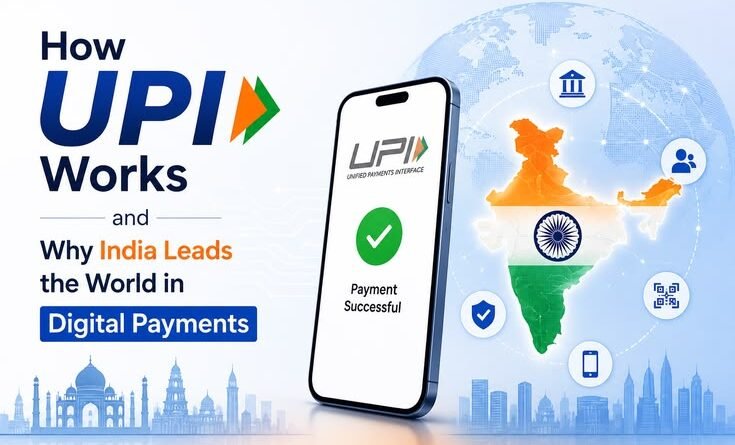
How UPI Works and Why India Leads the World in Digital Payments
How UPI Works and Why India Leads the World in Digital Payments
Last month, I was at a tiny roadside dhaba somewhere on the outskirts of Jaipur — the kind of place with plastic chairs, a ceiling fan that wobbles like it’s about to give up, and the most incredible dal baati you’ve ever tasted. The bill came to ₹180. I reached for my wallet. The uncle running the place just pointed to a hand-laminated QR code taped to the wall with sticky tape, edges already curling in the heat.
I paid in four seconds. He got a chime on his phone. Done.
No card machine. No change drama. No “ATM nahi chala” excuses. Just a QR code stuck to a wall with cello tape doing the work of an entire banking infrastructure.
That moment honestly stuck with me. Because that uncle probably doesn’t know — or care — about fintech conferences or government policy papers. He just knows UPI works. And that’s the whole story, really.
So What Actually Is UPI?
UPI stands for Unified Payments Interface. It was built by NPCI — the National Payments Corporation of India — and launched back in 2016. But forget the full form for a second.
Here’s what it actually is in plain language: UPI is a system that lets any two bank accounts in India talk to each other, instantly, at any time of day, through a mobile app. It doesn’t matter which bank you’re with, which app you use, or whether it’s 3 AM on a Sunday. The money moves.
The key thing that makes UPI different from older systems like NEFT or IMPS is that it works through a virtual payment address — basically a UPI ID, something like yourname@okaxis or 9876543210@ybl. That ID is linked to your bank account, but you never have to share your actual account number or IFSC code with anyone. That alone was a massive unlock in terms of trust.
The Plumbing Behind the Magic
Okay, I’ll try to explain how it actually works without making your eyes glaze over.
When you open PhonePe, Google Pay, Paytm, or any other UPI app and tap “Pay,” here’s roughly what happens:
- You enter the recipient’s UPI ID or scan their QR code.
- Your app sends a payment request to your bank (via the UPI network).
- The UPI system routes the request to the recipient’s bank.
- You authenticate using your UPI PIN — a 4 or 6 digit number that only you know.
- Your bank verifies the PIN and deducts the amount.
- The recipient’s bank receives the funds.
- Both sides get a confirmation notification.
The whole thing happens in under 10 seconds. Sometimes under 3.
The backbone here is the IMPS (Immediate Payment Service) infrastructure, which is what actually moves the money 24/7. UPI basically sits on top of IMPS and makes it simple enough for your nani to use.
One thing a lot of people don’t realize: the app you use (PhonePe, GPay, etc.) isn’t the bank. These are third-party apps called PSPs — Payment Service Providers. They’re just the front door. The actual plumbing runs through your bank and the NPCI network. So if PhonePe ever shuts down tomorrow, your money is still sitting safe in your bank account.
Why India of All Places?
This is the part that surprises most people when I bring it up. India — a country where a huge portion of the population was unbanked just a decade ago — is now the single largest real-time payments market in the world. Not the US. Not China. India.
In FY2024, India processed over 100 billion UPI transactions. Let that sink in. 100 billion.
Several things came together to make this happen, and none of them were accidents:
Jan Dhan Yojana opened basic bank accounts for hundreds of millions of people who never had one. Suddenly there was a financial system they were part of.
Aadhaar created a digital identity infrastructure — biometric IDs for over a billion people — which could be linked to bank accounts. This made KYC (Know Your Customer) processes something that could happen on a phone instead of requiring a branch visit with four photocopies of your documents.
Cheap data. After Reliance Jio entered the market in 2016 — the same year UPI launched, not a coincidence — mobile internet became essentially free for hundreds of millions of Indians. A payment system is useless if people can’t afford to be online.
Zero MDR. This is a big one. MDR stands for Merchant Discount Rate — the fee that businesses pay when customers use cards. In India, the government mandated zero MDR on UPI transactions. That dhaba uncle doesn’t pay a single paisa to accept my ₹180 payment. That’s why even the smallest vendors adopted it.
Stack all of this together — bank accounts, digital identity, cheap internet, and no merchant fees — and you get the kind of adoption no marketing campaign could ever manufacture.
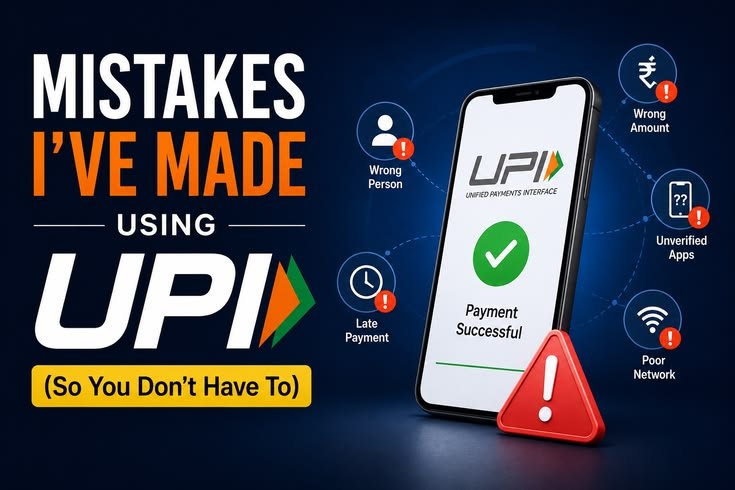
Mistakes I’ve Made Using UPI (So You Don’t Have To)
I’ve been using UPI since pretty much the beginning, and I’ve made my share of stupid mistakes.
The worst one: I once paid the wrong person because I typed a UPI ID from memory instead of copying it. Same first name, different person. The money went through instantly — that’s the thing about real-time payments, there’s no “processing” period where you can cancel. I had to request the money back from a stranger and wait, hoping they’d cooperate. They did, eventually. Lesson learned: always scan a QR code when you can, and always double-check the name shown before hitting confirm.
Another one: I linked a savings account to UPI that had a daily transaction limit I’d forgotten about. Tried to make a payment at midnight on a Sunday, got hit with a “limit exceeded” error, and had to use a backup app linked to a different account. Annoying but fixable. Keep two UPI apps linked to different accounts if payments are critical for your work.
Also — UPI PIN is not the same as your internet banking password. I’ve had friends confused about this. Your UPI PIN is something you set separately during UPI registration. Don’t share it. Don’t write it on your phone case. Treat it exactly like you’d treat an ATM PIN.
The International Angle
India isn’t keeping UPI to itself anymore. The system has already been deployed in several countries — you can now use UPI in Singapore, UAE, Bhutan, Nepal, France, and a few others. Indian travelers can scan QR codes abroad using their Indian UPI apps.
There’s also a bilateral arrangement where cards from some countries can scan Indian UPI QR codes. It’s still early days, but the ambition is clear: make UPI the global standard for real-time payments.
Other countries are paying attention. Brazil built Pix, which was partially inspired by the UPI model. The US has FedNow. But neither has achieved the kind of ubiquity India has — where a QR code on a wall in a village dhaba is completely normal.
What About Security?
I get asked this a lot. “Isn’t it risky? What if someone hacks your UPI?”
Here’s the thing: the security model is actually pretty solid. Every transaction requires your UPI PIN — which never leaves your device and is never transmitted in plain text. The apps use device binding too, meaning your UPI setup is tied to that specific phone’s SIM and device ID. If someone tries to set up your UPI ID on another phone, the existing registration gets invalidated.
The fraud that does happen isn’t really “hacking UPI.” It’s social engineering — someone calls pretending to be from your bank, convinces you to enter your UPI PIN on a “collect request” they’ve sent you, and you accidentally authorize a payment to them. The technology is fine. The attack surface is human psychology.
Rule of thumb: you never need to enter your UPI PIN to receive money. Only to send it. If anyone tells you otherwise, hang up.
Where Things Stand Today
Every time I think UPI has hit its ceiling, it surprises me again. Credit line on UPI, where you can now link credit products to your UPI ID. UPI for feature phones using a simple number-based flow called UPI 123PAY. Conversational payments through voice assistants. Recurring payments for subscriptions. Bill splitting. International remittances.
The system keeps expanding because the foundation is strong — a well-designed, government-backed, interoperable rail that nobody owns exclusively. PhonePe and Google Pay compete fiercely on the same infrastructure, which keeps innovation high and costs down for everyone.
What started as a fintech experiment has quietly become the most functional public infrastructure in the country. More reliable than the electricity grid in some areas, if I’m being honest.
That uncle at the dhaba with the laminated QR code taped to his wall? He’s not special. He’s just normal now. And that, more than any statistic, is how you know a technology has actually won.