
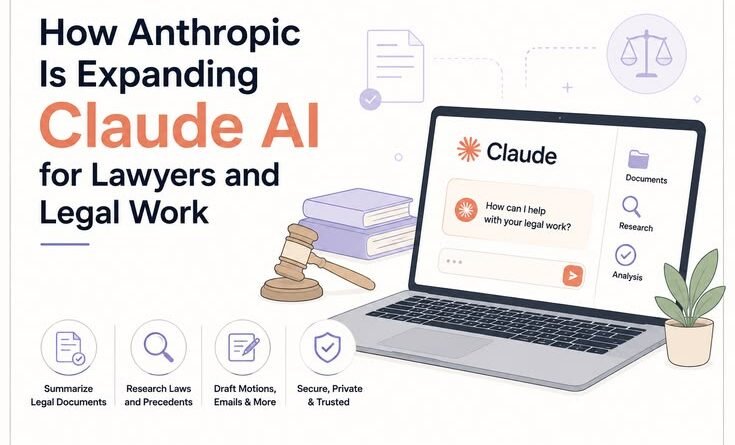
How Anthropic Is Expanding Claude AI for Lawyers and Legal Work
By a tech blogger who’s watched this space obsessively — and has the browser tabs to prove it.
A paralegal named Andrew was staring down an impossible situation. His four-person pro bono team — two lawyers, two paralegals — was squaring off against one of America’s top 200 law firms in an elder abuse case. No budget. No army of associates. Just grit, coffee, and Claude.
They won.
That story, shared by Mark Pike, Anthropic’s Associate General Counsel, says more about what’s happening in legal AI right now than any press release could. This isn’t just about BigLaw automating billing. It’s about a fundamental shift in who gets access to serious legal firepower — and Anthropic just made its most aggressive move yet.
What Anthropic Actually Announced (And Why It Matters)
On May 12, 2026, Anthropic officially launched Claude for Legal — a dedicated offering for law firms and in-house legal teams that goes way beyond “ask the chatbot a legal question.” Here’s what actually shipped:
12 role-specific AI plugins, including:
- Commercial counsel
- Employment counsel
- Litigation associate
- M&A due diligence
- Privacy counsel
- Law student (yes, even law students get their own plugin)
20+ Model Context Protocol (MCP) connectors that wire Claude directly into the software lawyers already live in every day — things like:
- iManage and NetDocuments (document management)
- Thomson Reuters Westlaw (the legal research database every law student fears and every attorney depends on)
- DocuSign, Box, Everlaw (eDiscovery), Harvey AI
And then there’s the Microsoft 365 integration — Claude embedded directly into Word, Outlook, Excel, and PowerPoint as a single context-carrying agent. If you know how lawyers actually work, you know this is the killer feature. Lawyers live in Word. Full stop.
Why Legal Work Is a Perfect Fit for Claude (And Why Claude Specifically)
I’ve been covering AI tools for a few years now, and I’ll be honest — when ChatGPT first launched, my instinct was to think legal work was one of the last places AI would make serious inroads. Legal work is precise. Stakes are high. One hallucinated case citation can sink a brief, damage a client, and get an attorney sanctioned.
But here’s what I missed: the volume of document work in law is staggering. A mid-sized firm might be managing thousands of pages of contracts, depositions, discovery documents, regulatory filings — all at once. The real bottleneck has never been legal reasoning. It’s been reading, organizing, cross-referencing, and drafting at scale.
That’s where Claude has a specific edge. According to Anthropic’s own Mark Pike, “legal work requires in-depth document comprehension — from tracking defined terms across exhibits and schedules to understanding how the document holds together.” Claude’s unusually long context window and its ability to maintain coherent understanding across massive documents makes it genuinely well-suited here.
Christopher Kercher, a partner at Quinn Emanuel who built the firm’s litigation platform on Claude — reportedly with almost no coding background — described his approach like this: treat Claude as a member of the case team. Onboard it the way you’d onboard a partner joining mid-case: give it the chronology, key excerpts, case themes. The output, he said, went far beyond what he could have produced on his own.
That framing stuck with me. It’s not “AI replaces lawyer.” It’s “AI becomes a very capable junior member of the team who has read every document.”
The Hallucination Problem: Real, But Being Addressed
Let’s not gloss over the awkward part. The same week Anthropic announced this expansion, Sullivan & Cromwell — a white-shoe firm if there ever was one — was caught by opposing counsel having included a hallucination in a bankruptcy court filing. Judges have issued sanctions. Bar associations have issued warnings. California fined an attorney for submitting an AI-generated appeal full of fake quotes.
So yes, the risks are real. And they’re not theoretical.
Anthropic’s answer to this is what they call grounding — building the connector architecture so Claude draws from live, verified sources rather than synthesizing answers from training data memory. When a lawyer asks about a case, Claude isn’t guessing from what it learned during training. It’s reading from Westlaw’s actual database of court records and opinions in real time.
Jay Madheswaran, CEO of Eve (a legal AI company built on Claude), put it bluntly: “In litigation, an authoritative-sounding hallucination is worse than no answer.” His company tests every model against 24+ legal-specific benchmarks — citation accuracy, ungrounded case quotes, memory leakage, refusal correctness. Claude, he said, wins their internal evaluations on the metrics that matter most for legal work.
This isn’t a solved problem. But grounding to verified, live data sources is the right architectural response. It’s the difference between asking someone what they remember from law school versus handing them the actual casebook.
Who’s Already Using This (And What They’re Saying)
Freshfields, one of the world’s most prestigious law firms, has gone essentially all-in with Claude. Partner Gerrit Beckhaus described Claude’s capabilities as an “essential part” of their proprietary AI-powered solutions, and said the firm is co-developing agentic workflows with Anthropic — multi-step legal tasks handled end-to-end.
The numbers Anthropic shared are striking too. Legal became the number one power-user job function in Claude Cowork, with over three times the usage of any other professional category. A single webinar on how legal teams use Claude drew more than 20,000 registrations.
That’s not a niche experiment. That’s a industry-wide scramble.
The Access-to-Justice Angle (This Part Doesn’t Get Enough Attention)
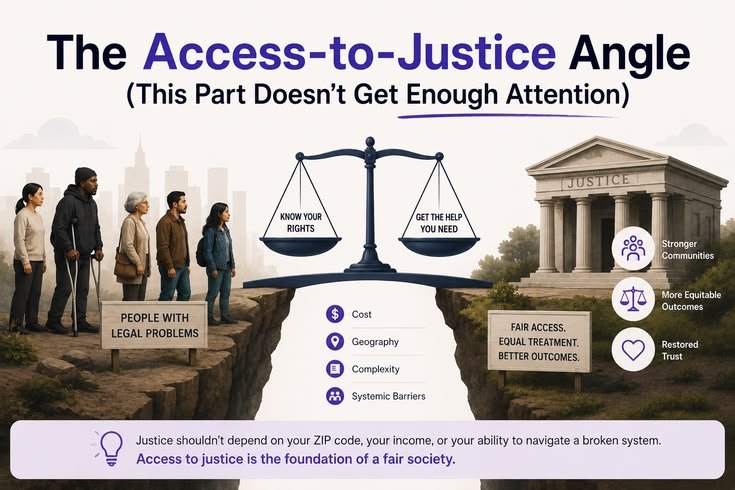
Here’s the piece of this story that most tech coverage buries at the bottom: roughly 80% of civil litigants in the United States appear in court without a lawyer. Eighty percent. The legal system has a representation gap that’s been growing for decades.
Anthropic is making an explicit access-to-justice argument alongside its BigLaw pitch. Through partnerships with organizations like the Free Law Project and Courtroom5, connectors designed for legal aid and public service work will be available to Claude users at no additional cost.
That pro bono team that beat the AmLaw 200 firm? That’s the model. A small team with access to the right AI tools can punch dramatically above their weight class. This matters for individual litigants trying to navigate housing court, family court, immigration proceedings — people who currently face those systems alone.
I don’t want to oversell it. AI tools don’t replace experienced attorneys, and the stakes in these situations are too high for anyone to pretend otherwise. But the gap between “no legal help” and “some structured, AI-assisted legal help” is enormous. Closing even part of that gap matters.
Common Mistakes to Avoid If You’re a Legal Professional Using AI
Having talked with several attorneys and legal ops folks who’ve experimented with AI tools, a few patterns keep coming up:
1. Treating AI output as final. The fastest way to get yourself in trouble is submitting anything AI-generated without thorough review. Use Claude to draft, organize, and research — then verify everything, especially citations, independently.
2. Using generic prompts for specialized work. “Summarize this contract” is fine. But the Quinn Emanuel approach is better: give Claude context, role, case background, and specific goals. The more context you provide upfront, the more useful the output.
3. Ignoring jurisdiction. AI models often default to federal law or the most common jurisdictions. Always specify the jurisdiction you’re working in, and verify that cited statutes and cases actually apply to your context.
4. Not leveraging the integrations. The real power of Claude for Legal isn’t the chatbot — it’s the connectors. Claude reading your actual iManage documents, your actual Westlaw search results, your actual DocuSign contracts, is a fundamentally different (and safer) experience than Claude generating answers from training data alone.
5. Skipping the “law student” plugin if you’re junior. The law student plugin is underrated. It’s designed to explain complex legal concepts, help with research structure, and provide the kind of mentorship scaffolding that junior associates often struggle to get. If you’re early in your career, this is worth exploring.
Where This Is All Heading
The legal AI market is moving fast — Harvey just raised $200 million at an $11 billion valuation; Legora raised $600 million. Anthropic’s move positions Claude not just as the invisible model underneath these tools, but as a direct participant in legal workflows. That puts Anthropic in complex territory with partners like Thomson Reuters, which is simultaneously giving Claude access to Westlaw data and competing with its own AI products.
This competitive tension is going to get interesting. But from where I sit, the competition is good news for lawyers and legal teams. More options, more integrations, more pressure on providers to actually solve the hallucination and grounding problems that have caused real harm in real courtrooms.
Legal AI isn’t a futuristic concept anymore. It’s already in the briefs, the contracts, the depositions, and yes, apparently, the elder abuse case where the small team won.
The question now isn’t whether AI will be part of legal work. It’s whether the lawyers using it will be disciplined, careful, and informed enough to use it well.
The tools are here. The integrations are live. The track record is still being written — one verified citation at a time.



Pingback: Why Apple Intelligence Is Becoming One of Apple’s Biggest Software Upgrades Ever – MSR Technical