
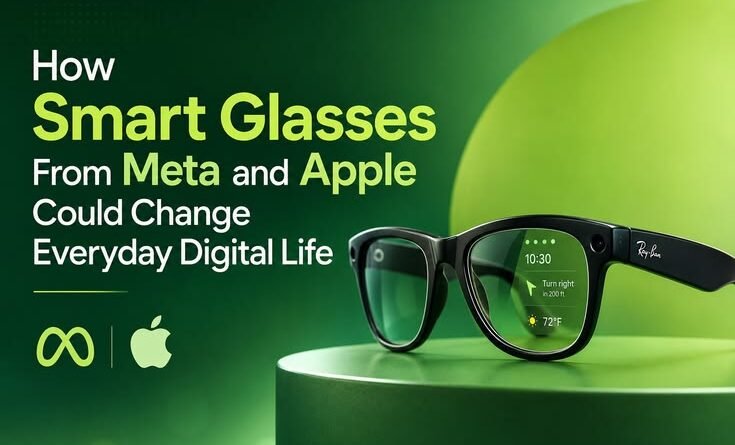
How Smart Glasses From Meta and Apple Could Change Everyday Digital Life
Last month, I was sitting at a café in Bangalore, trying to do three things at once — check my messages, look up directions to my next meeting, and not spill my coffee. My phone was out, my earbuds were in, and I probably looked like someone having a mild existential crisis. A guy at the next table caught me struggling and said, “You need those Ray-Ban Meta glasses, man. I’ve been using them for two months. It’s different.”
That stuck with me. I went home, did a deep dive, borrowed a pair from a friend who’d imported them, and spent two weeks going back and forth between my usual setup and this strange new world where your glasses are also your assistant. Here’s what I found — the good, the frustrating, and the genuinely surprising.
The Basic Idea — And Why It’s Actually Different This Time
Smart glasses have been “the next big thing” since Google Glass launched in 2013 and promptly became a social disaster. People hated being around them. The cameras made strangers uncomfortable. The tech wasn’t ready. The whole thing collapsed.
But that was over a decade ago. What Meta is doing with the Ray-Ban Meta glasses — and what Apple is reportedly building toward with its own rumored smart glasses — is a fundamentally different approach. Instead of slapping a screen in front of your eye, they’re focused on audio-first interaction, cameras that feel natural, and AI assistants that actually understand context.
Meta’s current glasses let you make calls, play music, take photos and short videos, and talk to Meta AI hands-free. Apple, based on everything leaked and discussed in the developer community, is working on something with deeper integration into the iOS ecosystem — think Siri on your face, but smarter and more spatially aware.
The shift isn’t just hardware. It’s about where computing lives — and whether it belongs strapped to your wrist, held in your hand, or sitting on your nose.
What Two Weeks With Ray-Ban Meta Glasses Actually Taught Me
I’ll be honest: the first day felt weird. Not bad-weird — just unfamiliar. I kept reaching for my phone out of habit even though I could’ve just said “Hey Meta, what’s the weather?” and gotten an answer in my ear.
The audio quality surprised me most. These aren’t earbuds, so the sound leaks — people nearby can faintly hear what you’re listening to. In a quiet library, that’d be awkward. On a busy street or in a market, it’s totally fine. I used them mostly for music during my morning walk and podcast listening while cooking, and for those use cases, they were genuinely excellent.
The camera is where it gets interesting. The glasses have a small camera built into the frame. I used it to capture candid moments during a family dinner — just a tap on the frame and it shoots. No pulling out a phone, no missing the moment while fumbling with the camera app. The photos aren’t DSLR-level, but for spontaneous memories, they’re great.
The AI assistant — this is the part that’s growing fast. I asked it to identify a plant in my backyard (it got it right), read out a message I’d received, and summarize a voice memo. It wasn’t perfect every time, but it worked well enough that I started to rely on it more than I expected.
Where Apple’s Version Could Go Further
Apple hasn’t officially released smart glasses yet, but the signals are everywhere — patents, developer discussions, supply chain leaks. Based on what’s been reported and what Apple has already built with Vision Pro, their glasses are expected to integrate deeply with iPhone, iPad, and Mac workflows.
Think about what that could look like practically:
You’re walking into a meeting. Your glasses recognize that your calendar shows a call in ten minutes, and Siri quietly reminds you in your ear — no buzz, no screen glance needed. You get on the call, and real-time transcription shows up in the corner of your vision (if it’s a display model). Someone shares a document — you see a soft overlay with the key points, pulled from your iPhone.
That’s not science fiction. That’s the logical extension of what Apple already does across its device ecosystem, just moved off the screen and into your field of view.
The difference between Meta’s approach and Apple’s anticipated approach is essentially this: Meta is building glasses that are a standalone device with AI baked in. Apple would likely build glasses that are a natural extension of your existing Apple devices — a screen layer and interaction layer, rather than a full computer on your face.
Both approaches make sense. They’re just solving different problems.
Real Use Cases That Actually Change Daily Life

Let me get specific, because “change everyday life” sounds vague until you break it down.
Navigation without looking down. If you’re walking in an unfamiliar city and your glasses can give you turn-by-turn directions through audio or a subtle visual cue, that changes how you experience a place. You can actually look around. You’re present. This alone is huge for travel.
Hands-free communication in situations where phones are awkward. I’m thinking of cooking, working out, commuting, or being in a meeting where grabbing your phone is rude. Glasses let you stay connected without the social friction of screen time.
Instant translation. Meta’s glasses have started rolling out translation features. Point at a sign in another language, hear the translation. For someone like me who travels frequently, this is practical in a way that Google Translate on a phone never quite matched — because it requires zero friction.
Accessibility. For people with visual impairment or cognitive differences, audio-guided AI that narrates context — what’s in front of you, who’s speaking, what a text says — is genuinely life-changing, not just convenient.
Photography without disruption. I’ve mentioned this already, but it deserves its own point. The best camera is the one you actually use. Glasses that can capture moments without asking you to stop being in the moment? That’s a real behavioral shift.
Mistakes I Made (And What to Learn From Them)
I wore the glasses into a cinema once, forgetting they had a camera. Someone on the staff noticed the indicator light and asked me to remove them. Fair enough — but I hadn’t thought through the social context. Lesson: you need to be aware of how others perceive the camera, even when you have zero bad intent.
I also tried using them during a video call where I needed to screen-share. The glasses couldn’t help with that at all — I was back on my laptop immediately. Don’t overestimate what they can replace. They’re a complement to your existing devices, not a replacement.
Battery life was another reality check. About four to five hours of active use before they needed charging. For a full workday, you’d be topping them up at lunch. Not a dealbreaker, but plan accordingly.
The Social Side Nobody Talks About Enough
Here’s the thing that surprised me most: people around me didn’t react negatively the way they did to Google Glass. Partly because the Ray-Ban design looks like regular glasses. Partly because the cultural moment is different — we’re more used to wearables now.
But there’s still an unspoken awkwardness when people realize you might be recording or listening to something while talking to them. Transparency matters. I started mentioning it upfront in conversations — “Hey, I’ve got these smart glasses on, just so you know” — and that completely changed the dynamic. People got curious, not defensive.
Apple, with its brand reputation for thoughtful design, will likely address this with camera indicators and privacy features baked in from the start. Meta has already added an LED light that turns on when recording. These small things matter enormously for adoption.
What’s Coming and How to Think About It
Both Meta and Apple are moving toward something bigger: persistent, ambient computing. The idea that your digital layer isn’t something you pull out of your pocket but something that lives with you, on you, all the time.
That’s a profound shift in how we relate to technology. Done well, it frees us from the phone-as-center-of-life pattern that honestly hasn’t been great for attention spans or real-world presence. Done poorly, it creates a new layer of distraction and surveillance anxiety.
The honest answer is: it depends on the choices the companies make, the choices regulators make, and the choices each of us makes about how to use these tools.
For now, if you’re curious about smart glasses, the Meta Ray-Ban glasses are the most accessible entry point — they’re available in India now, priced in the mid-range, and the use cases I described are all real and functional today. Not flawless, but real.
Apple’s version, whenever it arrives, will probably be the one that converts the skeptics — because it’ll be deeply woven into the ecosystem half the world is already living in.
My takeaway after two weeks? I didn’t replace my phone. I didn’t transform my life overnight. But I did start noticing how often I reach for my screen out of reflex, not necessity. And that small moment of awareness — that tiny gap between stimulus and grab — is where something interesting is starting to grow.
Smart glasses aren’t going to delete your phone from existence. But they might, quietly, start asking whether your phone should be the center of everything.
That’s worth paying attention to.




Pingback: How Anthropic Is Expanding Claude AI for Lawyers and Legal Work – MSR Technical