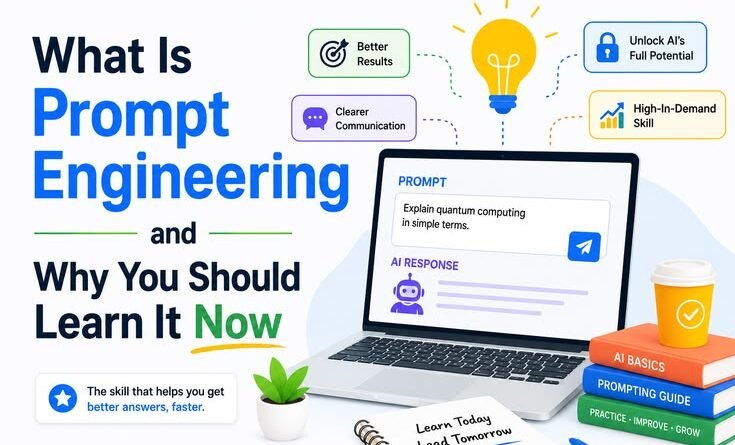
What Is Prompt Engineering and Why You Should Learn It Now
I Spent 3 Months Talking to AI Wrong — Here’s What I Finally Figured Out
Let me tell you about the moment I realized I had been doing everything wrong.
When I was working late on a client project — a marketing strategy document that needed to go out the next morning. I pulled up ChatGPT, typed something like “write me a marketing strategy for a fitness brand,” and hit enter. What came back was… technically fine. Generic, safe, forgettable. The kind of stuff that reads like it was assembled by a committee of people who’ve never actually bought a protein shake.
I spent another two hours trying to fix it. Rewriting paragraphs, adding personality, making it actually useful. By 1 AM I was frustrated and exhausted.
A colleague looked over my shoulder the next day and said, “How did you prompt it?” I stared at him blankly. Prompt it? I just… asked it a thing.
That was my introduction to prompt engineering. And honestly? It changed how I work more than any other single skill I’ve picked up in the last five years.
So What Actually Is Prompt Engineering?
Here’s the thing — the name sounds way more technical than it actually is. When most people hear “engineering,” they picture someone in a hard hat or hunched over lines of code. Forget that image entirely.
Prompt engineering is basically the art of knowing how to talk to AI tools so they give you genuinely useful output instead of generic garbage.
That’s it. That’s the whole thing at its core.
The “engineering” part just means you’re being deliberate and structured about it — like a chef following a recipe instead of just throwing random ingredients into a pan and hoping for the best.
Every time you type something into ChatGPT, Claude, Gemini, or any other AI tool, that text is your prompt. Prompt engineering is simply the skill of crafting those prompts thoughtfully so the AI actually understands what you need, in what format, at what level of detail, and in what tone.
Why Most People Get Terrible Results From AI
Here’s what I’ve noticed after helping a bunch of friends and coworkers start using AI tools — almost everyone makes the same mistakes I did.
They treat the AI like a search engine. You don’t type “cheap flights Mumbai to Delhi” into ChatGPT and expect it to book your ticket. But people apply that same terse, keyword-style input and then wonder why the output is shallow.
They give zero context. “Write an email” is not a prompt. Who is it for? What’s the relationship? What’s the goal of the email? Is it a first contact or a follow-up? What tone do you want? The AI is not psychic — it fills in the blanks with assumptions, and those assumptions are almost always wrong for your specific situation.
They don’t tell it what role to play. This sounds weird but trust me — if you tell Claude or ChatGPT to respond as a “senior copywriter with 15 years of experience in B2B SaaS marketing,” you will get a fundamentally different answer than if you just ask it to “write marketing copy.” The AI shifts its entire frame of reference.
And they accept the first answer. Almost nobody does this in real life. If you hired a human freelancer and their first draft was mediocre, you’d give feedback. Do the same with AI.
The Building Blocks of a Good Prompt
Once I actually started learning this stuff, I realized there’s a loose framework that works across almost every AI tool. Here’s how I think about it now:
Role — Tell it who to be. “Act as a UX designer reviewing a mobile app interface.” “You are an experienced tax consultant in India.” This primes the AI to draw from relevant knowledge and speak in the right voice.
Context — Give it the situation. What’s the background? Who’s the audience? What’s the goal? The more relevant context you drop in, the better the output. Yes, this means longer prompts. Yes, it’s worth it.
Task — Be specific about what you actually want. Not “write something about climate change” but “write a 500-word explainer about how urban heat islands affect electricity bills, aimed at people who have no science background.”
Format — Tell it how you want the answer delivered. Bullet points? A table? Step-by-step numbered instructions? A casual blog post? A formal report? If you don’t specify, it guesses — and it often guesses wrong for your use case.
Constraints — Any limits or rules. “Keep it under 300 words.” “Don’t use technical jargon.” “Avoid mentioning competitors.” “Write in an Indian English style.”
You don’t need to use all five in every prompt. But the more you consciously think about these elements, the more consistently useful your results become.
Real Examples From My Own Work

Let me make this concrete. Here’s a before-and-after from actual prompts I’ve used.
Before: “Give me ideas for a YouTube channel about cooking.”
After: “I’m starting a YouTube channel targeting working professionals in Indian metro cities who want to cook healthy meals in under 30 minutes. They’re time-crunched, not great cooks, and mostly cooking for one or two people. Give me 10 specific video ideas that would genuinely solve their problems, and for each one, explain why it would work for this audience.”
The second prompt got me ideas I could actually use. One of them — a video about batch cooking dal in different flavors for the whole week — became the most-watched video on the channel in the first month.
That difference? Prompt engineering.
Mistakes I Still See People Making
Even after people learn the basics, there are some habits that keep tripping them up.
Being vague about tone. “Make it friendly” means different things to different people — and to AI, it’s almost meaningless without an example or comparison. Try “write this the way a knowledgeable friend would explain it at a coffee shop, not like a corporate press release.”
Not iterating. The first response is rarely the final one. Build a conversation. Say “that’s good but make the opening more punchy” or “can you simplify the third paragraph for someone who doesn’t know industry terms?” AI tools are conversation partners, not vending machines.
Overloading one prompt. If you ask for ten different things in one prompt, you’ll get a mediocre version of all ten. Break complex tasks into steps. First get the outline, then flesh out each section separately.
Forgetting to ask for alternatives. This one is underrated. Add “give me three different versions of this” and you immediately expand your options. Sometimes the second or third version is the one that actually works.
Where to Actually Learn This Skill
The honest answer is: mostly by doing. But a few resources genuinely helped me develop the skill faster.
OpenAI and Anthropic both have published prompt engineering guides on their websites — dry reading, but full of useful technique. The Anthropic documentation especially goes deep on how Claude processes context, and understanding that changed how I write prompts for it specifically.
Learn Prompting (learnprompting.org) is probably the most accessible free resource out there. It reads like a normal tutorial rather than a research paper.
Coursera and DeepLearning.AI have formal courses — some are free, some are paid. If you work in a professional context where this skill has clear ROI, the paid ones are worth it.
But honestly? The best practice is picking one real project you’re working on right now and forcing yourself to do it entirely with AI tools. The friction you encounter is the lesson.
Why This Skill Matters More Than People Realize
Here’s the thing that took me a while to fully appreciate. Prompt engineering isn’t just a productivity hack — it’s becoming a fundamental literacy skill for working with information.
Every industry is integrating AI tools right now. Writers, developers, designers, lawyers, doctors, teachers, marketers — everyone is being handed these tools and expected to know what to do with them. Most people are going to use them badly and wonder why they don’t work well.
The people who understand how to communicate with these systems clearly and precisely are going to produce dramatically better outcomes than those who don’t. That’s not hype — I see it every week in the difference between my work and work from people who haven’t developed this skill.
And unlike learning to code or mastering Photoshop, this is a skill you can meaningfully develop in a few weeks of deliberate practice. The floor is low. The ceiling is genuinely high. And the window where this gives you a real competitive edge — before everyone figures it out — is probably narrower than most people think.
A Few Parting Thoughts
I think about that late night fumbling with a marketing document now and kind of laugh. I wasn’t failing because the AI was bad — I was failing because I didn’t know how to work with it. It was like blaming a piano for sounding bad when you’ve never taken a lesson.
Start small. Pick something you already do regularly — writing emails, summarizing articles, generating ideas, drafting reports — and just start experimenting with how you phrase your prompts. Keep notes on what works. Notice the patterns.
You’ll be surprised how quickly this compounds. And once it clicks, you won’t be able to imagine working without it.