
What Is Domain Authority and How to Improve It for Free
The exact moment when I got obsessed with Domain Authority. I had just spent three months writing blog posts for a client’s website — decent content, well-researched, properly formatted — and none of it was ranking. Meanwhile, a competitor with clearly thinner content was sitting comfortably on page one of Google.
A developer friend looked at both sites and said, “Bro, their DA is 41. Yours is 6. That’s your problem.”
I had no idea what he was talking about. I didn’t even know what DA stood for. That conversation sent me down a rabbit hole I haven’t fully climbed out of yet — and honestly, I’m glad it did.
So What Even Is Domain Authority?
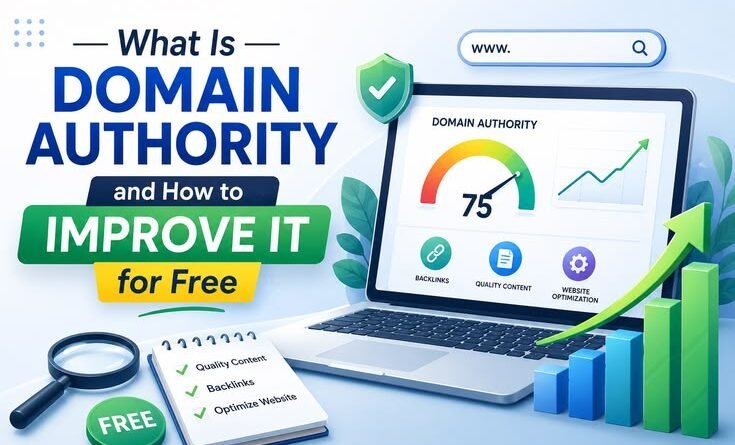
Domain Authority (DA) is a score developed by Moz that predicts how likely a website is to rank in search engine results. It runs on a scale of 1 to 100. The higher the number, the more “authority” your site supposedly has in Google’s eyes.
I say “supposedly” not to dismiss it — but because DA isn’t a Google metric. Google doesn’t use it directly. It’s Moz’s own algorithm, built by analyzing hundreds of factors, mainly the quality and quantity of backlinks pointing to your site.
Think of it like a reputation score at school. The new kid (your brand new website) starts with basically zero credibility. The popular kid who everyone talks about and refers to? They’ve got a high DA equivalent. Teachers (Google) are more likely to take their word seriously.
Other tools have their own versions — Ahrefs has Domain Rating (DR), SEMrush has Authority Score. They’re all measuring roughly the same thing with slightly different formulas. I personally check all three because no single score tells the full story.
Why Does It Actually Matter?
Here’s the honest answer: it matters because it correlates with ranking ability. Websites with higher DA tend to rank faster and for more competitive keywords. That’s just the reality I’ve seen across multiple projects.
When I started a personal finance blog a couple of years back, it sat at DA 1 for almost four months. No matter how good my content was, it was invisible. Once I crossed DA 20 — through the methods I’ll get into shortly — I started seeing real movement. Articles I’d written months ago suddenly climbed to page two and three.
It’s not magic. It’s momentum.
How DA Is Calculated (The Simple Version)
You don’t need to understand the full algorithm, but knowing the basics helps you make smarter decisions.
Moz primarily looks at:
Linking Root Domains — How many unique websites link back to yours. One site linking to you ten times counts less than ten different sites linking once each.
Link Quality — A backlink from the New York Times is worth astronomically more than one from a random blog with zero traffic.
Internal Link Structure — How well your own site is connected internally.
Overall Site Age and Trust — Older, established domains with clean histories tend to have higher baseline authority.
The big takeaway: backlinks are king. Almost everything in DA improvement comes back to earning quality links.
Improving Your DA — What Actually Worked for Me
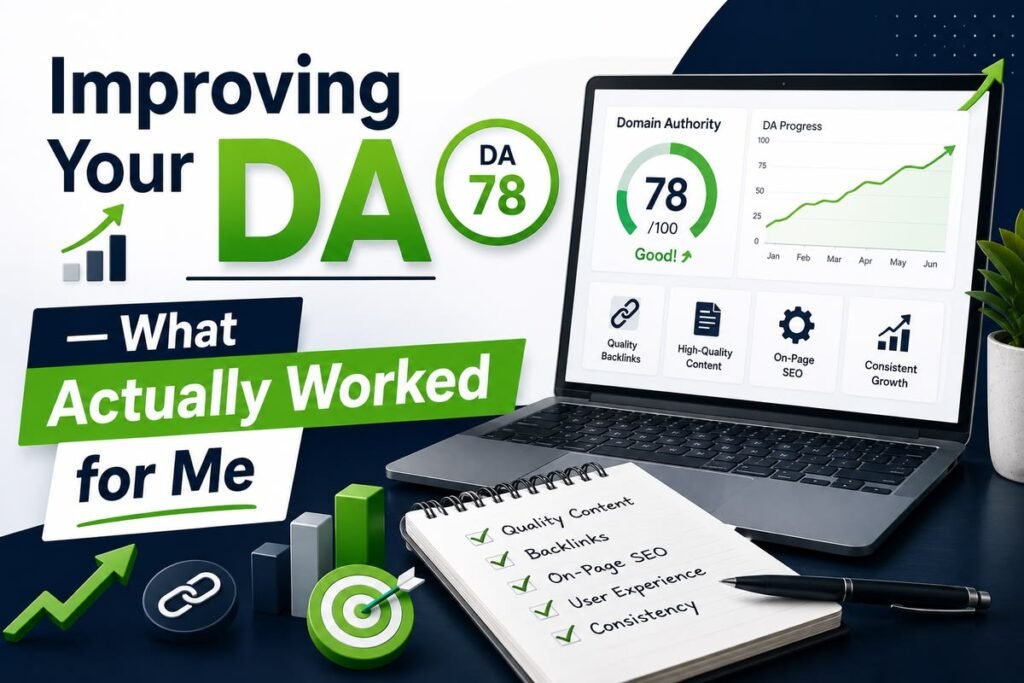
Let me be real with you: there are no shortcuts that last. I tried a few sketchy ones early on (bought a cheap backlink package off Fiverr — never again). Google penalized the site and it took six months to recover. Lesson learned the painful way.
Here’s what genuinely moved the needle without spending money:
1. Write Content Worth Linking To
This sounds obvious, but most people skip it. Before obsessing over link-building tactics, I started asking myself: “Would I bookmark this article? Would I reference it in my own work?”
Long-form guides, original data, free tools, and “ultimate” resource posts attract links naturally. My highest DA gains have always come from content that answered a question no one else had answered well yet.
One article I wrote — a beginner’s glossary for a niche industry — ended up getting referenced by three university blog posts without me doing anything. That single month pushed my DA from 18 to 23.
2. Guest Posting (The Right Way)
Guest posting still works. I write one or two guest posts a month on blogs that are relevant to my niche and have a DA higher than mine. The key is to pitch genuinely useful topics, not just “please link to me” requests.
Find sites using Google search operators like: "write for us" + [your niche] or "guest post" + [your topic]
I use Moz’s free Link Explorer or Ahrefs’ free version to check the DA of sites before pitching. No point guest posting on a DA 3 site — it won’t help you.
3. Broken Link Building
This one is underrated and completely free. The idea: find websites in your niche that have broken outbound links, then suggest your content as a replacement.
I use a Chrome extension called Check My Links (free) to scan pages for broken links. Then I reach out to the site owner with a polite, short email explaining the broken link and suggesting my relevant article as a replacement. Response rate is low — maybe 10-15% — but the links you do get are legitimate and appreciated.
4. Get Listed on Resource Pages and Directories
Every niche has “best tools,” “useful resources,” or “where to learn” type pages. Getting your site mentioned on these is gold.
Search: "resources" + [your niche] or "useful links" + [your topic]
For a local business site I was helping, I got them listed on three local chamber of commerce directories and two industry-specific resource pages — all free. DA jumped 6 points in about two months.
5. Reclaim Unlinked Brand Mentions
This was a game changer I discovered almost by accident. I searched my site’s name in Google and found that two different blogs had mentioned it without actually linking to me. I emailed both politely. One linked back immediately. The other never replied — but one out of two isn’t bad.
Use Google Alerts (completely free) to monitor mentions of your brand, blog name, or key articles. Whenever you get mentioned without a link, reach out and ask for one. Most people are happy to add it since they already cited you.
6. Fix Your Internal Linking
This is the most overlooked free tactic. Internal links distribute “link juice” across your site and help Google understand your content hierarchy. Every new post I publish, I go back to three or four older posts and add links to the new one.
Also make sure your most important pages (homepage, cornerstone content) are well-linked from everywhere else on your site.
Common Mistakes That Actually Hurt Your DA
Buying links — Already mentioned this. Moz and Google both punish this. The temporary bump isn’t worth the risk.
Ignoring toxic backlinks — Random spam sites sometimes link to you without permission. Use Google Search Console’s Disavow Tool to remove these links. I do a cleanup audit every few months.
Chasing quantity over quality — Getting 50 links from garbage sites is worse than getting 2 links from strong, relevant domains. Always prioritize relevance and authority.
Obsessing over DA daily — DA doesn’t update in real time. Moz refreshes it roughly once a month. I’ve seen people lose their minds checking it every day. Set a monthly review cadence and move on with your life.
Neglecting on-page SEO — DA is about off-site authority, but if your site is slow, has broken pages, or thin content, you’re working against yourself. Run a free crawl on Screaming Frog (free up to 500 URLs) or use Google Search Console to catch technical issues.
Realistic Expectations
If you’re starting from scratch, here’s roughly what I’ve seen in terms of timelines with consistent effort:
- DA 1–10: First few weeks to a couple months
- DA 10–20: 3–6 months of consistent link building
- DA 20–30: 6–12 months, depending on niche competition
- DA 30+: This is where things get genuinely exciting — and harder
Getting from DA 30 to 40 is significantly harder than getting from 5 to 15. The scale isn’t linear — it’s logarithmic. Don’t get discouraged when progress slows at the top end.
The Free Tools I Actually Use
- Moz Link Explorer (free plan) — Check your DA and competitors
- Ahrefs Webmaster Tools (free) — Backlink monitoring for your own site
- Google Search Console — Inbound links, crawl issues, performance data
- Check My Links (Chrome extension) — Broken link hunting
- Google Alerts — Brand mention monitoring
- Screaming Frog (free up to 500 URLs) — Technical SEO audits
You don’t need to pay for anything to make meaningful progress, especially in the early stages.
One Last Thing
Domain Authority is a tool for direction, not a final destination. I’ve worked with sites that had DA 15 and were crushing it for local keywords. I’ve also seen DA 40 sites with barely any traffic because they ignored content quality.
The metric matters. But what it’s measuring — genuine, earned credibility on the web — matters even more. Build that, and the number follows on its own.
Start with one tactic this week. Pick broken link building or brand mention reclamation — both take under two hours to get started and cost nothing. Small consistent actions compound faster than you’d expect.