What Is Augmented Reality and How Will It Change Daily Life?
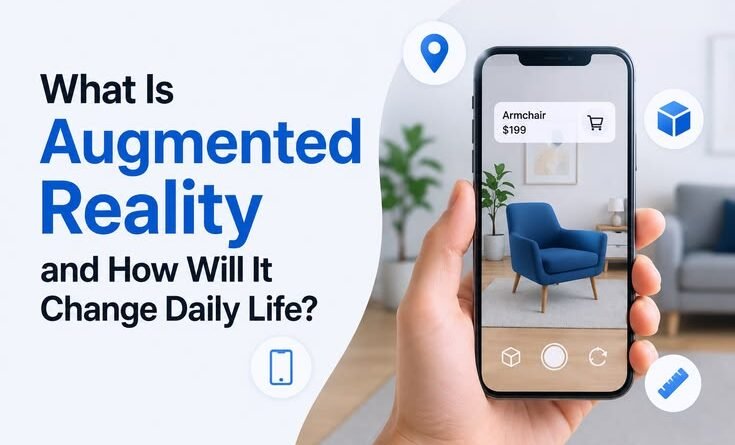
I still remember the first time augmented reality genuinely surprised me. I was standing in IKEA, holding my phone up to my living room floor on the app, and watching a virtual couch just appear there — sitting perfectly in the corner like it had always been there. I moved it around. Tried a different color. My wife leaned over my shoulder and said, “Oh wow, that actually fits.”
We bought the couch. It fit perfectly.
That was a few years ago, and honestly, that one experience shifted how I think about technology. Not because it was flashy, but because it was useful. It solved a real problem I had — “Will this couch look stupid in my living room?” — in about 45 seconds.
That’s augmented reality at its best.
So What Actually Is Augmented Reality?
Here’s the simple version: augmented reality (AR) layers digital information — images, text, 3D objects, sounds — on top of the real world you’re already looking at. You’re not being transported somewhere else like with VR (virtual reality). You’re still standing in your kitchen, your office, your street — but now there’s extra information or objects added to what you see.
Your phone camera becomes a window. The world becomes a canvas.
The IKEA app I mentioned? That’s AR. So is the yellow first-down line you see during an NFL broadcast. So is Snapchat’s dog filter (we’ve all used it, don’t pretend you haven’t). And so are those navigation arrows that appear floating above the road in Google Maps when you use Live View mode.
AR has been quietly slipping into everyday life for years. Most people just haven’t noticed it has a name.
The Stuff That’s Already Changing How We Live
Shopping Will Never Be the Same
Let me be honest — I used to buy things online and return half of them. Clothes that didn’t fit right. A lamp that looked nothing like the product photo. A desk that turned out to be embarrassingly tiny.
AR is starting to fix this in ways that feel almost unfair compared to the old way.
Apps like Warby Parker let you try on glasses through your phone camera before you order. Amazon has a “View in Your Room” feature for furniture and décor. Sephora’s Virtual Artist lets you try on lipstick shades and eyeshadow without touching a tester (especially relevant post-pandemic).
The result? Fewer bad purchases. Less waste. Less disappointment.
I tried the Warby Parker app while writing this section, just to see. Picked three frames I liked, held up my phone, and spent ten minutes trying on glasses I never would have ordered otherwise. Ended up going with a pair I’d normally have dismissed — and they look great. That would have been a missed sale for them and a missed pair for me without AR.
Navigation That Actually Makes Sense to Normal People
Anyone else completely incapable of reading a flat map and turning it into real-world directions? Just me? Okay.
Google Maps’ Live View mode changed things for me. You open the camera, walk forward, and arrows appear floating on the actual street in front of you. Turn left at the coffee shop, not “in 40 meters.” It’s a small thing, but it’s the kind of small thing that saves you from standing on a corner looking lost while definitely being lost.
Apple Maps has something similar. And cities like London and Tokyo have started experimenting with AR wayfinding at transit stations — hold your phone up, and signage appears telling you exactly which exit to take.
For tourists and people with directional challenges (again, just me?), this is genuinely life-changing.
Healthcare — Where AR Gets Seriously Impressive
This one took me a while to fully appreciate, but the more I read about it, the more it floors me.
Surgeons at hospitals like Johns Hopkins have started using AR headsets — specifically Microsoft HoloLens — during spine surgeries. The headset projects the patient’s CT scan directly onto their body in real-time during the operation. The surgeon can see exactly where to make incisions without looking away at a separate screen.
One trial showed a significant improvement in accuracy compared to traditional methods. For something like spinal surgery, where a millimeter matters, that’s not a minor upgrade.
Medical students are training on AR simulations. Nurses are using AR apps to find veins more accurately for injections. Physical therapists are using AR to guide patients through exercises at home.
We’re not fully there yet — most of this is still in specialized settings. But the direction is clear.
Education — Finally Making Abstract Things Concrete
I struggled with chemistry in school. Molecular structures felt like nonsense on a page. If I’d had an app that let me rotate a 3D molecule in my hand, turn it, pull it apart, see how the bonds worked… I genuinely think I’d have understood it faster.
Apps like Merge Cube and platforms like Google Expeditions are doing exactly this for kids today. You hold a physical cube, and your phone sees it and projects a virtual object onto it — a human heart, a dinosaur skeleton, a solar system. Kids can hold the moon. Rotate Mars. Watch a cell divide.
Teachers who’ve used these tools consistently say the same thing: engagement goes through the roof. Kids who zone out during traditional lessons are suddenly leaning forward.
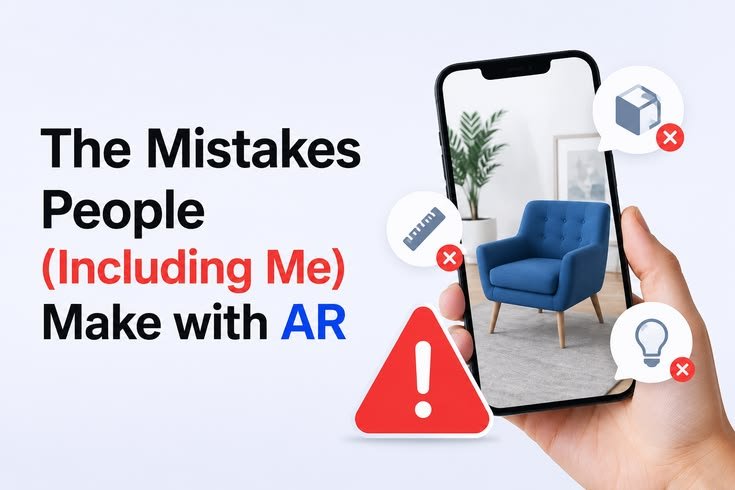
The Mistakes People (Including Me) Make with AR
Here’s the thing nobody tells you about early-stage technology: you’ll overhype it and then get disillusioned, and both reactions are wrong.
Mistake #1: Expecting perfection too soon. I tested an AR navigation app on a cloudy day and it was basically useless — the camera struggled to recognize landmarks. Frustrating. But that’s a sunlight and sensor issue, not a reason to dismiss the technology entirely. It works brilliantly in good conditions and is improving fast.
Mistake #2: Ignoring the privacy side. AR apps — especially those using your camera constantly — raise real questions. Who sees what your camera sees? Where does that data go? I always check app permissions now before enabling camera access for any AR feature. Worth doing.
Mistake #3: Assuming AR equals VR equals the metaverse. These three things get thrown together constantly and they’re genuinely different. VR replaces your world. AR adds to it. The metaverse (whatever that becomes) is a persistent virtual space you inhabit. AR is the most practical of the three for everyday life right now.
Mistake #4: Thinking it’s just for young people. My dad — 62, not what you’d call a tech enthusiast — spent 20 minutes using an AR app to figure out if a new shed would block his garden’s sunlight. He figured it out himself. The best AR is intuitive enough that age doesn’t matter.
What’s Coming That Should Actually Excite You
AR glasses are the obvious next step, and they’re closer than you think.
Meta’s Ray-Ban smart glasses (the newer versions) have started incorporating AR-style overlays. Apple’s Vision Pro blurs the line between AR and VR in ways that point toward where wearables are heading. Google is reportedly working on new AR glasses after the Google Glass misfire a decade ago (yes, the timing was wrong then — doesn’t mean the concept was).
The real shift will happen when AR moves off your phone and onto something you wear without thinking about it. Glasses, eventually. Maybe contact lenses. When the hardware becomes invisible, AR becomes ambient — just part of how you experience the world.
Think about what that means practically:
- You look at a restaurant and see its rating and busy hours floating above the door
- You glance at someone at a conference and their LinkedIn profile appears (with their permission, ideally)
- You look at a broken appliance and step-by-step repair instructions appear overlaid on the actual machine
- You walk into a store and your shopping list highlights the items as you pass them on shelves
None of that is science fiction. Versions of all of it exist in prototype or early commercial form today.
The Honest Take — What to Actually Pay Attention To
AR won’t fix everything, and it’ll create new problems we can’t fully predict yet. Screen addiction is already real — AR has the potential to make that significantly worse if the technology is built poorly or exploitatively. There are accessibility concerns. There are serious questions about how AR advertising will work when brands can put virtual billboards anywhere in your field of vision.
These aren’t reasons to be afraid. They’re reasons to pay attention.
The people who’ll benefit most from AR aren’t necessarily the early adopters buying every new headset — they’re the ones who stay curious, try the useful stuff (like that IKEA app), ignore the gimmicks, and think critically about the tools they invite into their lives.
Start small. Download Google Maps and try Live View next time you’re somewhere unfamiliar. Use the IKEA Place app before your next furniture decision. Try on glasses with Warby Parker. These aren’t demos — they’re genuinely useful right now.
AR isn’t coming. It’s already here, doing quiet, practical things that make real decisions easier. Most of us are already using it. We just haven’t started calling it by its name.